
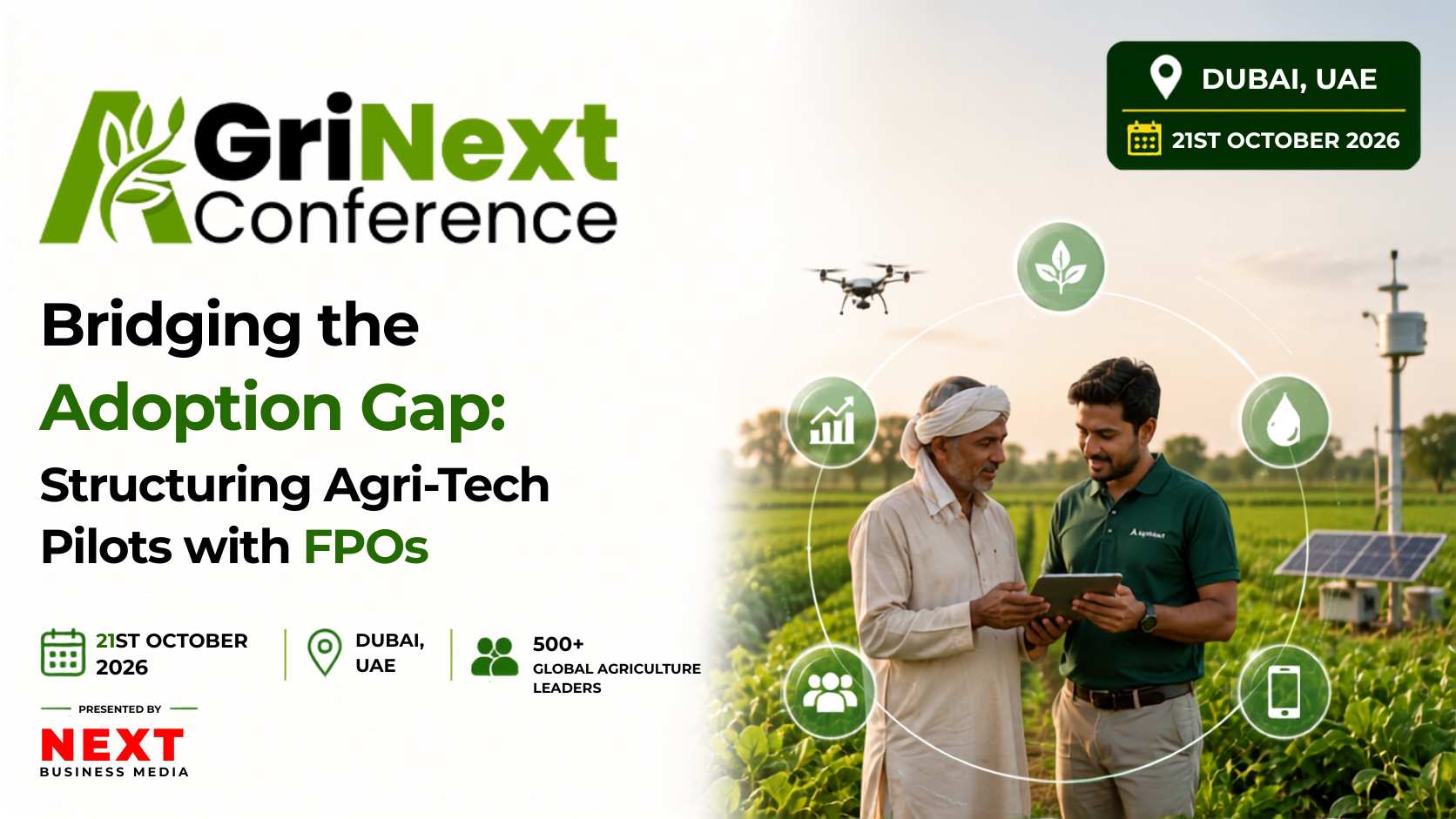
The global agri-tech sector does not suffer from a lack of innovation. From AI-driven predictive agronomy and satellite-powered crop analytics to smart irrigation and digital marketplaces, the technology pipeline is expanding rapidly. Yet a persistent adoption gap remains.
For enterprises seeking to scale these solutions, the challenge is increasingly less about proving that the technology works and more about designing an effective deployment model.
The path from technological innovation to commercial adoption requires enterprises to move beyond fragmented, individual-farmer outreach. One increasingly important route is to structure formal technology pilots through Farmer Producer Organizations (FPOs), which can provide an institutional bridge between technology providers and large groups of smallholder farmers.
The Bottleneck of Theoretical Innovation
For years, agri-tech companies have invested heavily in sophisticated platforms, dashboards and data-driven tools. While these technologies may perform effectively in controlled or digitally mature environments, rural deployment introduces a different set of challenges.
Fragmented landholdings, high customer acquisition costs, limited digital capacity, localized operating conditions and the need to build trust can make direct farmer-by-farmer deployment expensive and difficult to scale.
This is where aggregation becomes commercially important. India’s Small Farmers’ Agri-Business Consortium (SFAC) describes producer organizations as a mechanism for improving small and marginal farmers’ access to investment, technology and markets while creating forward and backward supply-chain linkages.
Why FPOs matter
FPOs bring farmers together through an organized commercial structure. Depending on their maturity and operating model, they can support collective input procurement, aggregation, market access, training and supply-chain coordination.
For an agri-tech enterprise, this creates a more efficient entry point into rural markets. Instead of acquiring and supporting hundreds of farmers individually, the technology provider can work with an institutional partner that already has relationships with its members.
The value extends beyond customer acquisition. FPOs can help technology providers understand local production conditions, coordinate field-level deployment and establish feedback loops between farmers and technology teams.
For enterprises seeking traceable sourcing and more predictable supply, an FPO should therefore be viewed not merely as a development partner, but as a potential commercial gateway.
Three pillars of a scalable FPO pilot
To avoid pilots becoming short-term demonstrations or CSR initiatives, enterprises need to design them as structured commercial experiments. Three elements are particularly important.
1. Co-Designing for Shared Incentives
Enterprises should avoid introducing pre-packaged technology without first understanding the FPO’s commercial priorities.
The pilot should begin with a clearly defined problem: high input costs, inefficient irrigation, post-harvest losses, inconsistent quality, weak market access or limited visibility across the supply chain.
Consider an automated irrigation system. The success metric should not simply be the number of sensors deployed or the volume of data generated. It should be linked to measurable outcomes such as reduced water consumption, lower energy costs, improved crop quality or increased farm-level returns.
This shift from technology-led deployment to outcome-led design creates a stronger business case for both the FPO and the technology provider.
2. The Train-the-Trainer Operational Model
Deploying enterprise teams to support thousands of individual farmers is neither operationally practical nor financially sustainable.
A more scalable model is to train FPO managers, field executives and selected farmer leaders who can become local technology champions. They can support onboarding, basic troubleshooting, data collection and farmer engagement.
The enterprise can then focus on the areas where it has the greatest comparative advantage: technology improvement, analytics, platform management and performance evaluation.
This creates a localized support ecosystem rather than making the technology provider responsible for every field-level interaction.
3. Move from Free Trials to Shared-Cost Models
The objective of a pilot should ultimately be commercial adoption. Completely subsidized trials can sometimes produce engagement that disappears when the subsidy ends.
A better approach is to establish financial commitment early. Depending on the technology and FPO’s capacity, this could involve a shared-cost model, subscription structure, performance-linked pricing or financing through an agri-focused financial institution.
The principle is simple: the pilot should test not only whether farmers can use the technology, but whether the value generated is sufficient to support a sustainable business model.
The Enterprise Payoff: De-Risking the Supply Chain
For global enterprises, FPO partnerships can create value beyond technology adoption.
An organized farmer network can provide greater visibility into production practices, crop volumes, quality and supply conditions. Where appropriate data systems and governance are in place, this can strengthen traceability and improve supply-chain planning.
The model can also create a feedback loop. Farmers receive access to technology and services designed around their operational needs, while enterprises gain ground-level insights that can improve product development, forecasting and procurement strategies.
However, FPOs should not be treated as a shortcut around the complexity of rural markets. Their effectiveness depends on organizational capacity, member participation, financial sustainability and the quality of the partnership. SFAC itself notes that many FPOs continue to face challenges in developing viable and sustainable business models.
That makes pilot design even more important: enterprises need to select suitable FPO partners, define responsibilities clearly and build commercial models that create value for both sides.
AgriNext: Turning Agri-Tech Innovation into Scalable Impact
Bridging the agri-tech adoption gap requires collaboration across the agricultural ecosystem. Technology providers, FPOs, agribusinesses, investors, policymakers and researchers must work together to turn promising solutions into commercially viable, scalable models.
The AgriNext Awards & Conference brings these stakeholders together to explore emerging technologies, investment opportunities, sustainable agriculture and practical pathways for scaling innovation. It provides a platform to exchange insights, build partnerships and discuss how technology can deliver measurable value at the farm and enterprise level.
Join AgriNext to connect with industry leaders, explore emerging solutions and help shape the next phase of agricultural innovation.