
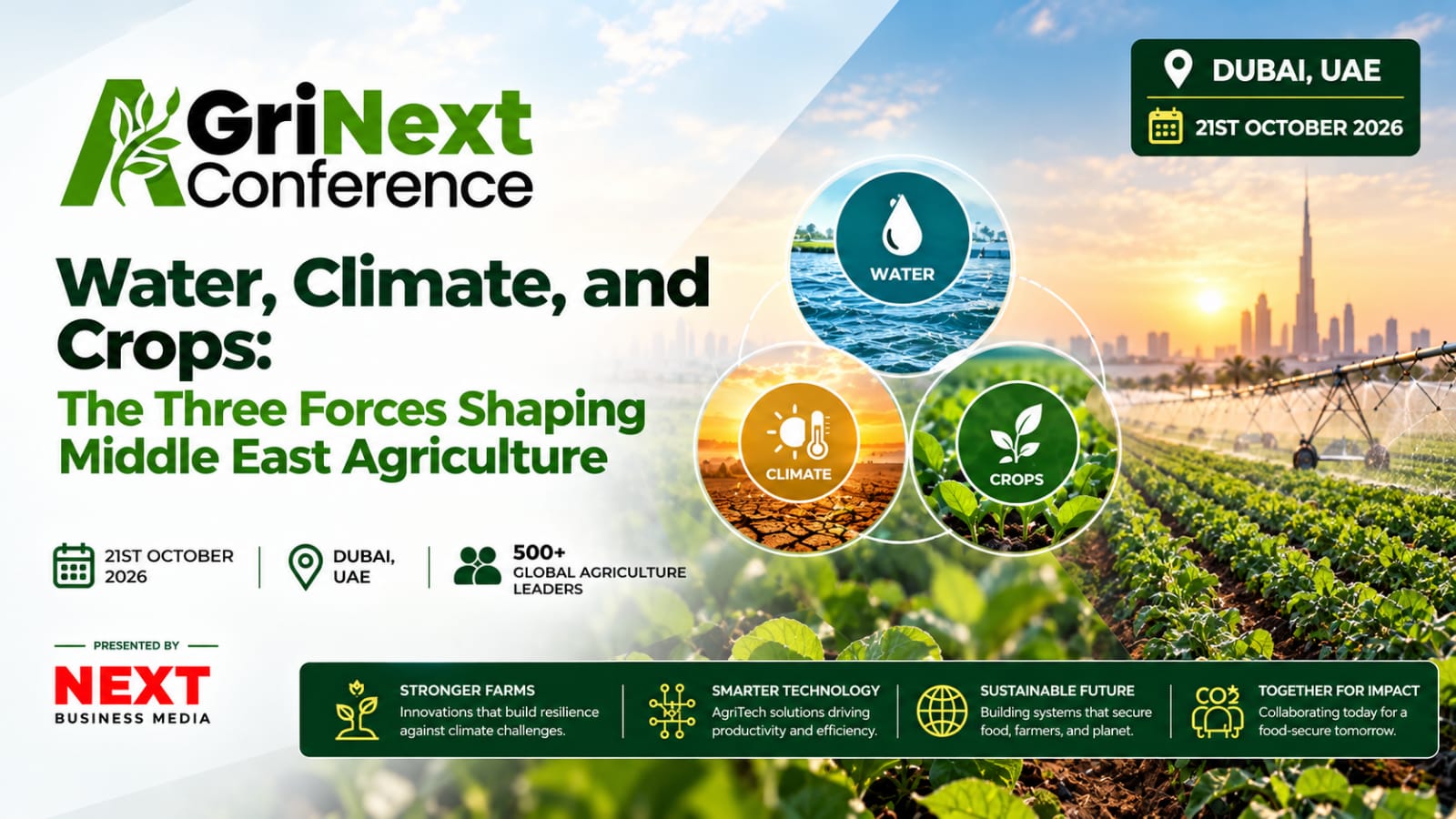
Agriculture in the Middle East is entering a defining era where water availability, climate volatility, and crop choices are becoming deeply interconnected. Across the region, food producers face a complex matrix of higher temperatures, shifting rainfall patterns, rapid soil degradation, and a surging demand for locally grown food.
The challenge is no longer simply about scaling production. The true goal is maximizing resource efficiency—cultivating the right crops with limited resources to build a truly resilient agricultural ecosystem.
Water Is Becoming the Central Agricultural Constraint
Water is fundamental to agricultural productivity, but freshwater resources across the Middle East are under substantial pressure. Agriculture is already the largest user of freshwater globally, with irrigation accounting for much of agricultural water demand. FAO notes that improving irrigation efficiency, water governance, water reuse, and other non-conventional water sources will be important for producing more food with less water.
For Middle Eastern agriculture, this makes water productivity as important as crop productivity. Technologies such as drip irrigation, precision irrigation, soil-moisture monitoring, remote sensing, automated irrigation controls, and data-driven crop management can help farmers apply water according to actual crop requirements.
Water reuse is another area receiving increasing attention. Treated wastewater, desalinated water, rainwater harvesting, and improved groundwater management can contribute to agricultural resilience when supported by appropriate safety standards and resource governance.
The objective is not simply to increase water supply. It is to improve how every unit of available water contributes to food production.
Climate Is Changing the Conditions for Crop Production
The regional agricultural challenge is being intensified by shifting climate conditions. The FAO projects that the Near East and North Africa region will become hotter and drier, increasing pressure on agricultural systems and exposing producers to greater drought and water-stress risks.
These changes can affect agriculture in several ways:
Higher evapotranspiration: Rising temperatures can increase evaporation and crop water requirements while intensifying heat stress during critical stages of crop development, including flowering and pollination.
Coastal vulnerabilities: Rising sea levels can contribute to saltwater intrusion in coastal areas, putting freshwater resources and agricultural land under additional pressure.
As a result, agricultural planning increasingly needs to account for climate risk alongside soil conditions, water availability, and market demand. Climate-smart agriculture—including heat- and drought-tolerant crop varieties, protected cultivation, improved irrigation, and localized weather and crop monitoring—can help producers adapt to changing conditions while using resources more efficiently.
Crop Choices Will Matter More
The third force is the transformation of what is grown and how it is produced. Faced with water and climate constraints, Middle Eastern agriculture is shifting toward drought-, heat-, and salinity-tolerant crops, protected cultivation, controlled-environment agriculture, and diversified, higher-value production systems that can generate greater value from limited water and land.
Across the Gulf, vertical farming and indoor agriculture are gaining attention as potential tools for strengthening local food production. These systems can provide greater control over temperature, humidity, irrigation, nutrients, and lighting while reducing exposure to external weather conditions. AI-driven climate control, IoT sensors, automated irrigation, and data-based nutrient management can further improve resource efficiency and help producers optimize growing conditions.
The wider shift is therefore not simply toward growing more food, but toward producing crops that are better suited to local environmental conditions and using technologies that can deliver greater productivity from constrained resources. For Middle Eastern agriculture, the ability to maximize yield and economic value per unit of water and land will become increasingly important.
From Resource Constraints to Agricultural Resilience
The relationship between water, climate, and crops points toward a more integrated model of agricultural development.
Water management determines what can be grown and how efficiently it can be produced. Climate conditions influence when and where crops can be cultivated. Crop selection, in turn, determines how much water, energy, land, and technology a production system requires.
This creates a broader water-energy-food nexus in which decisions in one area can affect the others. FAO highlights integrated water-energy-food approaches as part of the region's response to climate and agricultural challenges.
For governments, investors, farmers, technology providers, and food companies, the opportunity lies in developing systems that connect these three forces rather than treating them separately. Better data, efficient irrigation, resilient crop varieties, controlled-environment agriculture, water reuse, and stronger agricultural supply chains can all contribute to that transition.
The Middle East's agricultural future will not be defined by water availability alone. It will increasingly depend on how effectively the region manages water, adapts to climate change, and selects technologies and crops suited to its changing environment.
AgriNext Awards and Conference Dubai 2026
These themes will be central to conversations at AgriNext Awards & Conference Dubai 2026.The event will bring together agricultural leaders, investors, innovators, technology providers, and other stakeholders to explore developments shaping the future of agriculture, including resource efficiency, climate resilience, agri-technology, sustainable production, and food-system innovation.
Join AgriNext Dubai 2026 to connect with industry leaders, explore emerging agricultural solutions, and be part of the conversation on building more resilient and resource-efficient food systems.