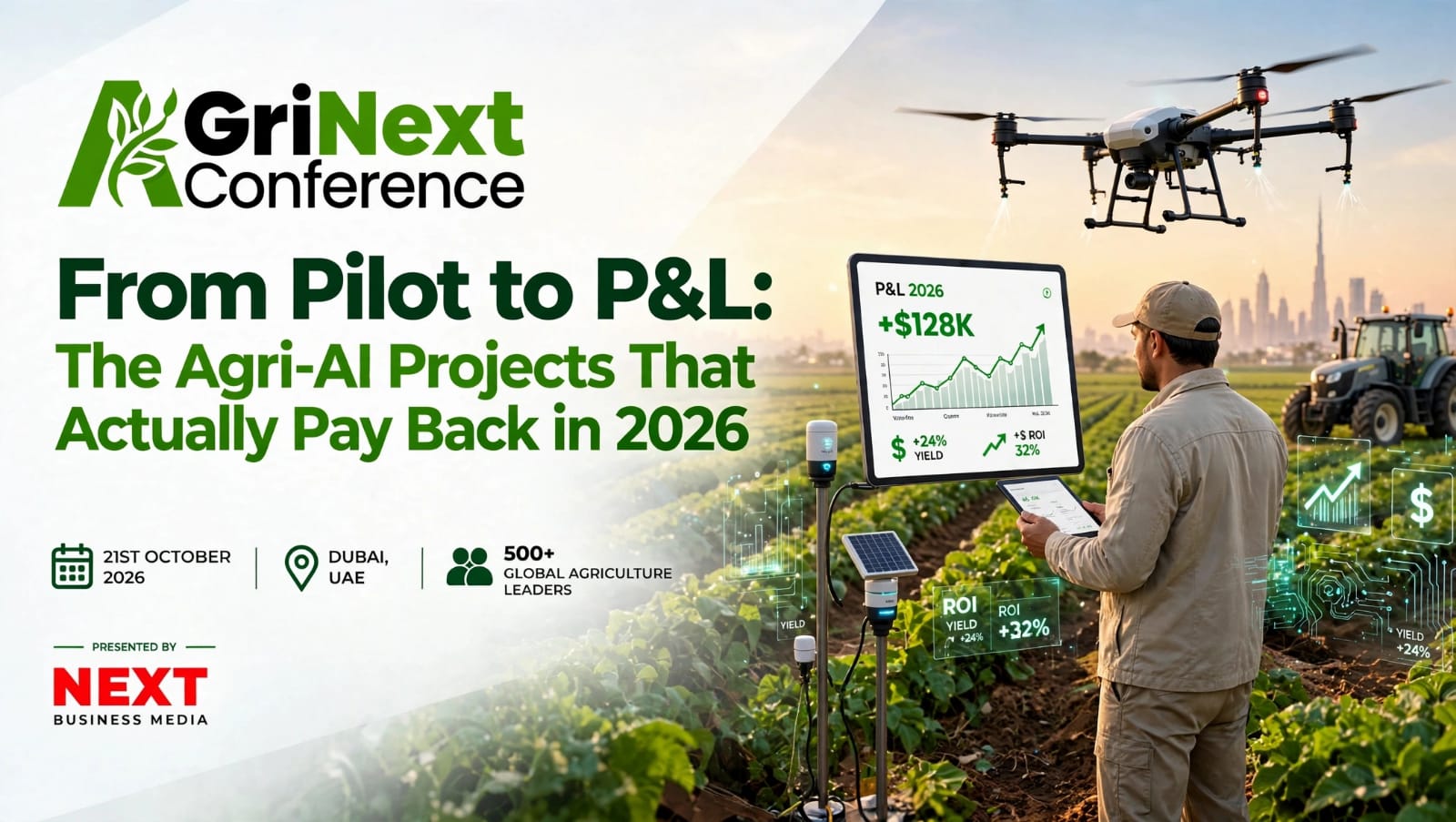
Artificial intelligence is moving from experimentation to practical use across agriculture. Machine learning, computer vision, edge IoT and autonomous robotics are helping farmers and agribusinesses raise yields, optimize input use and strengthen supply-chain visibility.
However, not every AI pilot creates measurable business value. In 2026, the strongest projects are those that connect technology to a clear operational or financial outcome, whether that means reducing water use, detecting crop problems earlier, improving yield forecasts or lowering supply-chain losses.
Key applications include AI-powered yield forecasting, precision irrigation, variable-rate input management, autonomous field machinery, disease and pest detection, generative AI for agronomic workflows, livestock monitoring and supply-chain traceability. The World Economic Forum’s Deep-Tech Revolution in Agriculture report highlights cases where integrated sensor, AI and automation solutions delivered yield gains of around 40% and water-use reductions of about 30%.
The focus, however, is shifting from what AI can do to what it can deliver. For agriculture businesses, the real test is whether an AI project moves beyond the pilot stage and produces measurable returns.
From technology pilots to business value
Many agricultural AI projects begin as small trials. A farm tests computer vision for crop monitoring, a company experiments with predictive analytics, or an agribusiness introduces AI-based forecasting. These pilots can demonstrate technical potential, but their real value comes when they solve a specific business problem.
The most effective projects start with a measurable objective. This can include reducing water use, improving yield consistency, lowering input costs, reducing crop losses or improving the accuracy of demand forecasts. AI becomes more valuable when its performance is measured against these outcomes rather than against the sophistication of the technology itself.
Precision irrigation delivers measurable savings
Water management remains one of the clearest areas for agricultural AI. AI-powered irrigation systems combine weather information, soil conditions, crop data and field observations to determine when and where crops need water.
Instead of applying the same amount of water across an entire field, growers can adjust irrigation according to changing conditions. This can reduce unnecessary water use while helping crops receive more consistent moisture.
The business case becomes stronger when water savings also reduce energy costs associated with pumping and distribution.
AI improves crop monitoring and early detection
Computer vision and machine learning are increasingly used to identify crop stress, disease symptoms and pest activity. Cameras mounted on drones, farm machinery or other platforms can collect images across large areas, while AI systems analyze these images for patterns that may be difficult to detect manually.
Early detection allows farmers to target interventions instead of treating entire fields unnecessarily. This can reduce chemical use, labor requirements and potential crop losses.
The financial benefit therefore comes not simply from identifying a disease, but from helping farmers act earlier and more precisely.
Better forecasting improves supply-chain planning
AI also plays an important role beyond the farm. Agricultural businesses use predictive models to forecast demand, production volumes, prices and supply requirements.
Accurate, field-level yield forecasts turn uncertainty into better working-capital planning. Computer vision on tractors, drone imagery and satellite data allow AI models to estimate harvest volumes earlier, helping packhouses, exporters and retailers plan labor, cold-chain capacity and promotions more effectively. On the finance side, verified yield signals can support parametric insurance and revenue-based lending by giving financial institutions better evidence of farm performance. India’s YES-TECH and FASAL programs show how remote-sensing-based yield estimation can scale across large areas for crop insurance and policy planning. YES-TECH blends satellite-derived yield models with crop-cutting data under PMFBY, while FASAL delivers pre-harvest production forecasts using multispectral and SAR satellite imagery.
The importance of connected farm data
AI cannot deliver reliable results without reliable data. Soil information, weather records, satellite imagery, machinery data and farm management records become more valuable when they are connected.
This means successful AI projects often require investment in data infrastructure before advanced models deliver their full value. Companies that build clean and accessible data systems create a stronger foundation for scaling AI across multiple farms and operations.
Measuring the return on AI
The strongest agricultural AI projects have a clear path from technology to financial impact. Businesses need to measure indicators such as input savings, yield improvement, labor efficiency, reduced losses and revenue gains.
The focus is therefore shifting from asking whether AI works to asking where AI creates the highest return.
In 2026, agricultural AI is increasingly judged by its contribution to the bottom line. The projects that move beyond pilots are those that solve practical problems, integrate with existing operations and deliver measurable economic value. For agriculture, the future of AI is not simply about smarter technology. It is about making better decisions that produce stronger returns.
Explore the Future of Agri-AI at AgriNext Dubai
Discover how AI, automation and data-driven technologies are improving productivity, efficiency and profitability across the agriculture value chain. Join industry leaders, innovators and investors at the AgriNext Awards & Conference Dubai 2026 on 21 October 2026 at the Al Thuraya Ballroom, Crowne Plaza Dubai – Deira by IHG to explore practical, ROI-focused agri‑AI solutions shaping the future of farming.