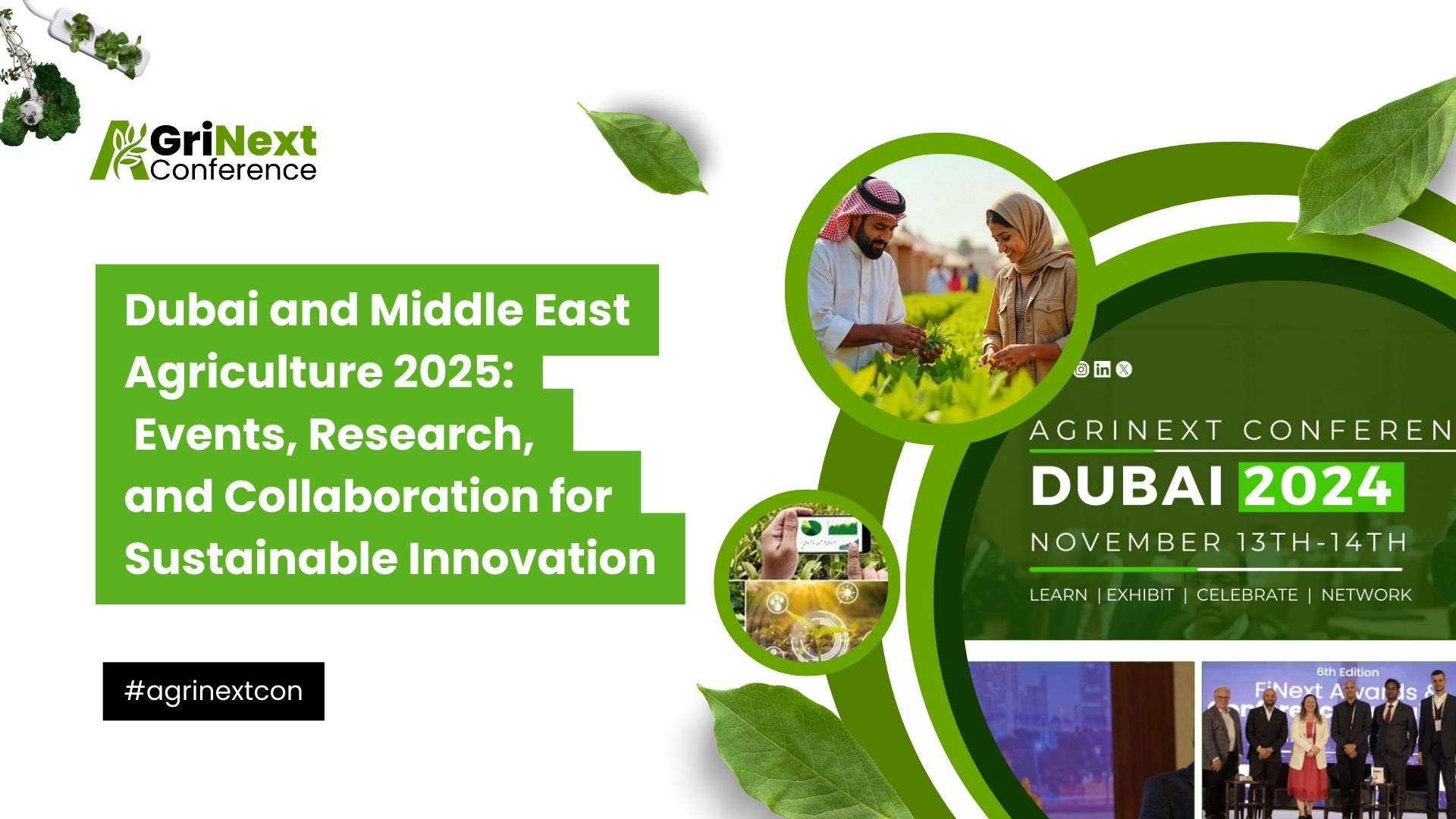
Agriculture in Dubai and the Middle East is entering a transformative era in 2025, where climate resilience, food security, and technological innovation take center stage. Despite severe water scarcity and arid landscapes, the region is witnessing breakthroughs in modern farming—supported by government initiatives, advanced irrigation techniques, and collaborative research efforts. Major events, tech-driven farming systems, and strong regional partnerships are positioning Dubai as a hub for scalable, sustainable agricultural solutions that shape the future of food across the Middle East.
Major Agriculture Events
2025 features several pivotal agriculture events in Dubai:
AgriNext Awards and Conference (November 5-6, 2025)
AgriNext Awards and Conference, returning on November 5–6, 2025, will spotlight technology-enabled farming innovations and explore the future of the agritech sector across the Middle East. Building on the success of its first edition, which brought together leading startups, policymakers, and investors to showcase breakthrough solutions, this year’s event will focus on scaling innovation and driving sustainable growth in regional agriculture.
AgroFarm Middle East & AgraME (October 6–7, 2025)
Aligned with national initiatives, this exhibition highlights innovation in animal farming, crop technologies, sustainable farming, and water management. It attracts global leaders for networking and collaboration.
World Agri-Tech Innovation Summit (December 8–9, 2025)
Gathers more than 300 senior decision makers from the agri-food value chain to accelerate climate-resilient agriculture, investment in new technologies, and partnerships in the MEASA region.
Gulfood 2026 (January 26–30, 2026)
Dubai World Trade Centre hosts this major food sector expo, fostering innovation and cross-cultural partnerships while spotlighting food system transformation.
Food Security SummitX (September 17–18, 2025)
The international event focused on uniting stakeholders across agri-tech and food security to catalyze action.
Collaborative Research Initiatives
The Middle East is strengthening its agricultural resilience through several collaborative research initiatives. The
University of Sharjah & DAVAS Prime Partnership is working on enhancing the use of glauconite, biochar, and biostimulants to improve desert soils. Supported by greenhouse and field trials, this research is helping boost soil fertility and crop yields in arid regions. Similarly, the ICARDA Regional Programs continue to play a crucial role by advancing knowledge-sharing and capacity-building across national institutions, engaging young scientists, and contributing to sustainable development and food security.
At the same time,INRAE Middle East Collaborations involve more than 92 active contracts with 41 partners, focusing on sustainable agriculture and climate-resilient innovation in arid zones. Adding to this, AARINENA Networks
are connecting experts across specialized sub-fields such as animal production, plant protection, and medicinal plants, fostering regional expertise and innovation through shared knowledge.
Government Policy and Technology
To meet the challenges of food security and climate resilience, the UAE and Dubai have launched ambitious policies and technology-driven initiatives. The National Food Security Strategy 2051 targets a 50% increase in local food production by harnessing modern systems like hydroponics and controlled environment agriculture. Complementing this, the Plant the Emirates Initiative seeks to expand productive farms by 20% and organic farming by 25%, while also cutting agri-waste by half within five years.
In parallel, Food Tech Valley and AgTech Parks are emerging as dedicated agritech zones that nurture startups, advanced research centers, and vertical farming leaders. On the technology front, solutions such as nano-clay for soil improvement, advanced water management systems, vertical farming, hydroponics, and AI-driven precision farming are being scaled rapidly. Together, these advancements are enabling food production in harsh desert environments and positioning Dubai as a global model for sustainable agriculture in arid regions.
Regional Impact and Collaboration
Collaboration is becoming the driving force behind agricultural progress in the Middle East. Across the MENA region, agri-food innovation and investment are unlocking new opportunities by enabling knowledge transfer, scientist mobility, and collective action on critical challenges such as water scarcity and biodiversity loss. Regional partnerships and joint research efforts are helping countries pool expertise, share resources, and accelerate solutions that individual nations might struggle to achieve alone.
Through these collaborations, networked events, and cross-border research initiatives, Arab countries are shaping holistic, climate-adaptive agricultural systems. The outcome is not only greater food security but also a long-term path toward sustainable farming practices that can withstand the pressures of climate change.
Conclusion
Dubai, through strategic events, research alliances, and agritech investments, is positioning itself as a global hub for sustainable agriculture. By combining policy support, cutting-edge technology, and regional collaboration, the Middle East is paving the way for climate-resilient, future-ready farming systems that secure food for generations to come.
Signup For AgriNext Conference Newsletter




 Reach us on WhatsApp