
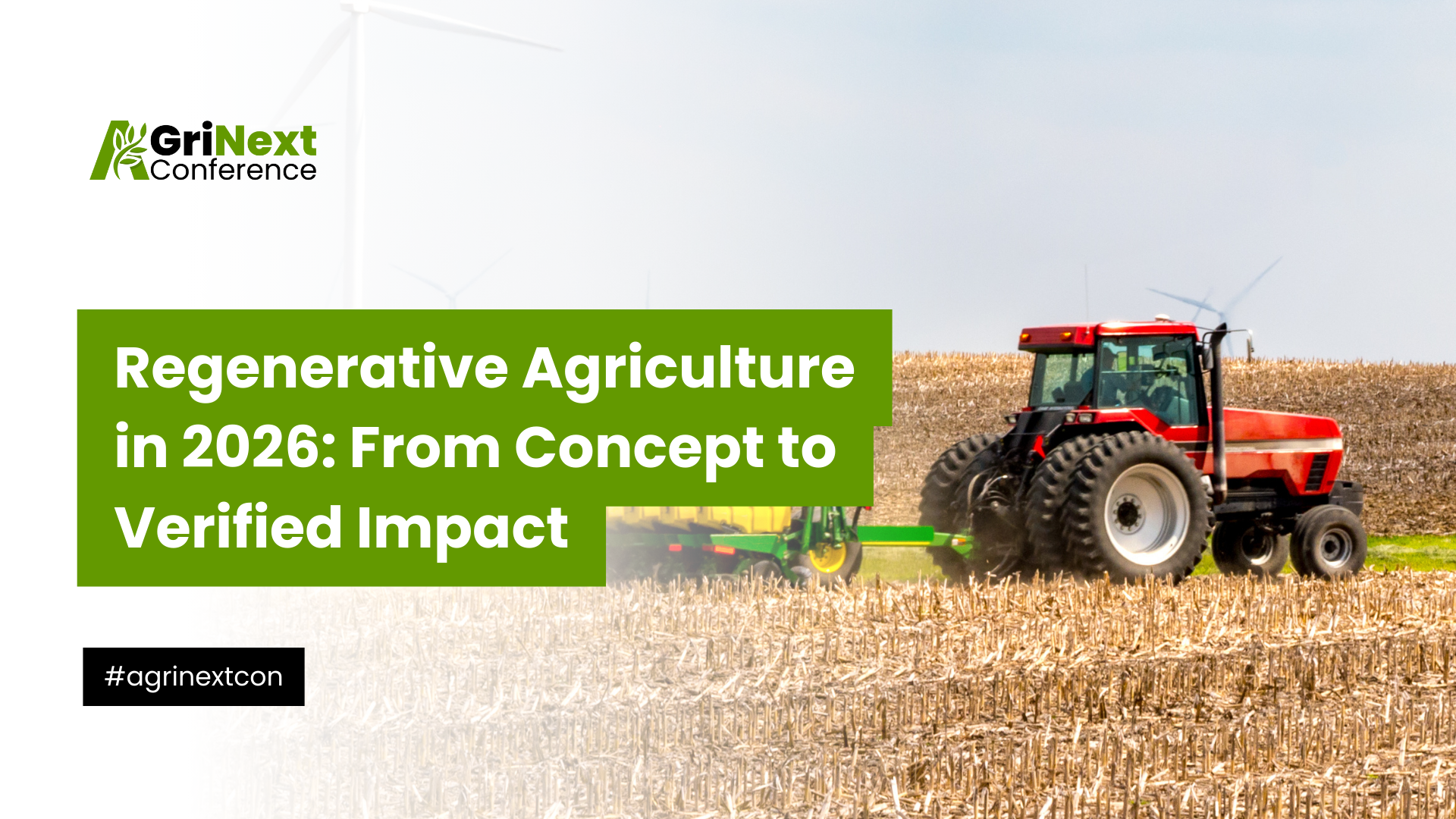
In 2026, regenerative agriculture is no longer a buzzword reserved for sustainability panels and pilot farms. It has moved decisively from conceptual promise to proven impact, backed by measurable carbon data, market expansion, and scalable agritech solutions. What once seemed idealistic is now economically rational—reshaping how food systems restore soil, protect biodiversity, and build resilience against climate shocks.
Across global and Indian contexts, regenerative agriculture (RA) is emerging as a practical response to environmental degradation while strengthening farmer livelihoods. This shift is driven by verified outcomes, policy alignment, and growing demand from both markets and consumers.
Market Momentum: Regenerative Agriculture Goes Mainstream
By 2026, regenerative agriculture has entered a phase of commercial maturity. The global market, valued at USD 1.52 billion in 2025, is projected to reach USD 5.77 billion by 2034, driven by ESG-linked investments, climate finance, and corporate net-zero commitments. Adoption is accelerating as regenerative practices move beyond pilots into large-scale programs supported by governments, food brands, and financial institutions.
Technology plays a central role in this growth. AI-based soil analytics, satellite monitoring, and digital farm management platforms enable scalable implementation while reducing input costs and climate risk. Public incentives for practices such as cover cropping, reduced tillage, and soil health restoration further reinforce regeneration as a viable, long-term farming model rather than a niche alternative.
Core Practices
Regenerative agriculture focuses on rebuilding soil ecology while maintaining productivity. Practices such as cover cropping, diversified rotations, organic amendments, and minimal soil disturbance enhance microbial activity, improve water retention, and increase carbon sequestration.
Evidence supporting these outcomes continues to strengthen. A large meta-analysis of 1,020 studies demonstrated that regenerative practices significantly increase soil organic carbon, with a mean effect size of 3.46, confirming strong sequestration potential. Cover crops alone sequester a median 0.55 metric tons of CO₂e per acre annually, with nearly 90% of observed plots reporting positive carbon outcomes. These results reinforce regeneration as a measurable climate solution rather than an assumed benefit.
India in the Global Regenerative Shift
India illustrates how regenerative agriculture can scale across diverse agro-climatic conditions.Andhra Pradesh’s Zero Budget Natural Farming (ZBNF) program integrates regenerative principles into public policy, reaching millions of farmers through initiatives such as PKVY. The model emphasizes low-input farming, soil restoration, and farmer resilience.
Private-sector participation is also growing. Organizations like the Crew Group have transitioned thousands of acres to regenerative systems for smallholders, enabling certification access and premium pricing. Together, public programs and private initiatives position India as a large-scale testing ground for regenerative agriculture that aligns local livelihoods with global sustainability goals.
Global Case Studies: Regeneration at Scale
Globally, regenerative agriculture is gaining traction across regions and commodities. Diageo works with farmers to integrate regenerative practices into sourcing networks, improving crop quality and long-term supply security. In the United States, rotational grazing models indicate that improved pasture management can offset 2–4% of agricultural emissions over extended periods. Meanwhile, Agri-PV systems, combining agriculture with solar energy production, are expanding rapidly at a 21.4% CAGR, enabling efficient land use for food and energy simultaneously.
The Path to Scalable Impact in 2026
In 2026, regenerative agriculture will be defined by verification and accountability. Carbon credits linked to soil data, third-party certifications, and digital MRV (Measurement, Reporting, and Verification) platforms will convert environmental outcomes into measurable economic value. AI-driven yield forecasting and soil analytics will reduce uncertainty, making regenerative systems more attractive to investors, insurers, and supply-chain partners.
Challenges such as transition costs, short-term yield variability, and knowledge gaps will persist, particularly for smallholders. However, expanding subsidies, public-private partnerships, and outcome-based financing models will continue to lower adoption barriers. Globally, scaling regenerative agriculture will align land restoration with net-zero targets, food security, and long-term economic resilience.
Event Spotlight :AgriNext Awards & Conference 2026
AgriNext 2026 will act as a global catalyst for regenerative and technology-led agriculture, convening policymakers, agribusiness leaders, and agri-tech innovators. The conference will highlight soil health, carbon verification, AI-enabled farming, and resilient food systems—accelerating the shift from sustainability commitments to measurable, scalable impact.
The future of farming will not be about producing more alone, but about regenerating what sustains agriculture—backed by evidence, data, and action.
Reference
Carbon Credits–Microsoft (MSFT) Signs 2.85 Million Soil Carbon Credit Deal With Indigo in Landmark Regenerative Agriculture Move
Signup For AgriNext Conference Newsletter


 Reach us on WhatsApp