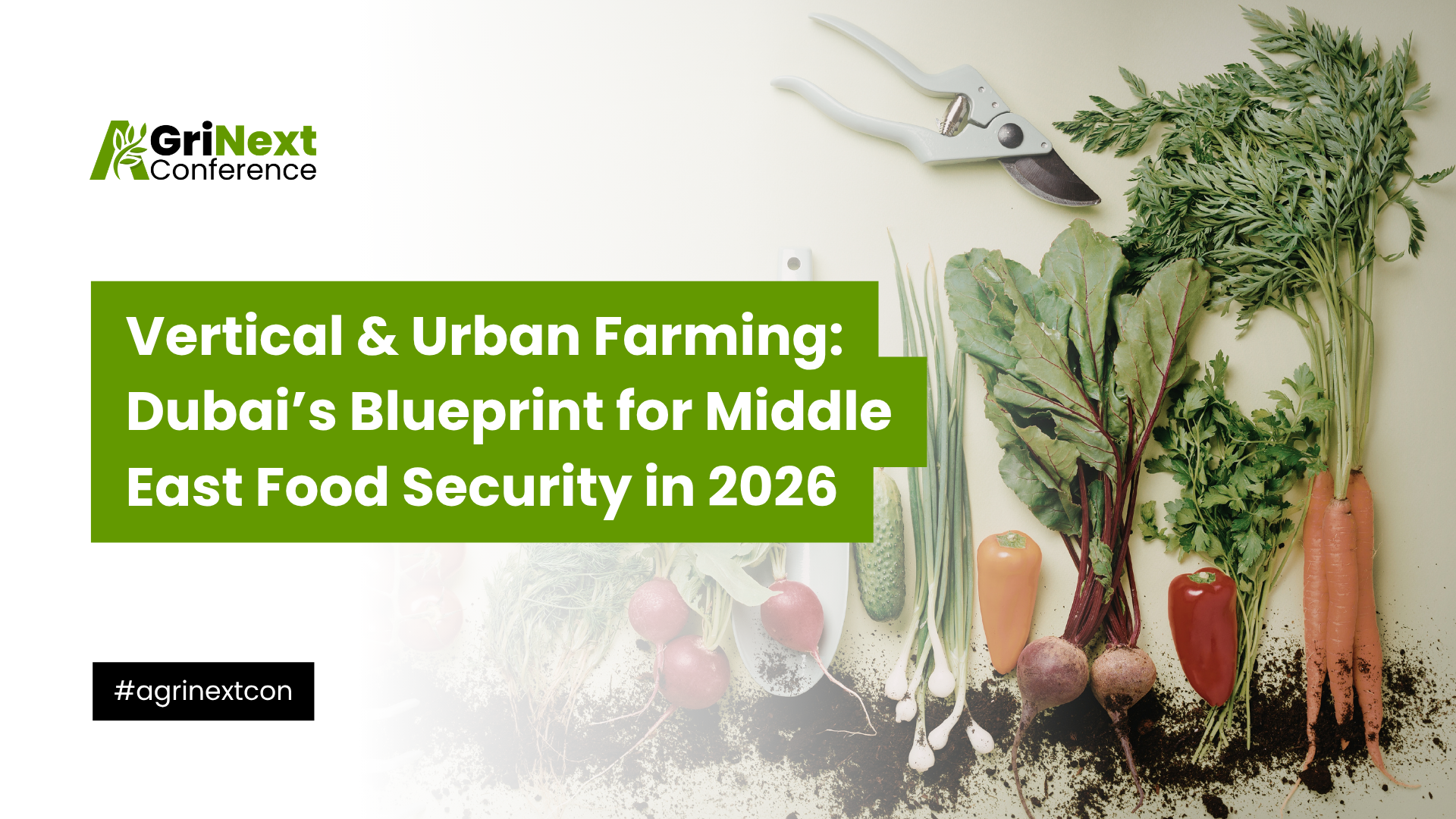
As we gather for AgriNext 2026 at the Crowne Plaza Dubai, the skyline isn’t the only thing reaching for the clouds. In 2026, Dubai has firmly established itself as the global capital of Controlled Environment Agriculture (CEA). It transforms the Arabian Desert’s extreme heat and water scarcity into a playground for AgTech innovation.
From Pilot Projects to Giga-Farms
Dubai has completed its transition from niche experiments to national infrastructure. The city now hosts some of history’s most ambitious vertical farming projects. Bustanica (Emirates Crop One) remains a titan in the industry; this 330,000-square-foot facility supplies over 1 million kilograms of pesticide-free leafy greens annually to Emirates flights and local retailers, using 95% less water than traditional field farming. The GigaFarm in Dubai’s Food Tech Valley stands as a 2026 landmark; it recycles 50,000 tonnes of food waste annually while yielding over 3 million kilograms of crops. Plenty & Mawarid’s joint venture, a $680 million initiative, scales indoor farming across the GCC; its 2026 expansion features a major Abu Dhabi facility producing 4.5 million pounds of strawberries annually.
The 2026 Tech Stack: Beyond Hydroponics
At AgriNext 2026, conversations have shifted from whether vertical farming works to how to optimize it for maximum efficiency. AI-driven autonomous farming leads the trends, integrating AI with robotics for harvesting and maintenance; these systems use predictive modeling to adjust CO2, humidity, and LED spectrums in real-time.
Middle Eastern farms now embrace post-hype optimization, learning from Western setbacks by adopting hybrid systems like Pure Harvest Smart Farms’ Smart Greenhouses, which blend natural sunlight with vertical stacking to cut high energy costs.
Crop diversification is also rising; while leafy greens dominate, farms like Greeneration in Dubai now supply premium edible flowers and microgreens to the city’s luxury dining sector.
Why Dubai? The Strategic Imperative
Vertical farming in the UAE has evolved beyond a tech marvel into a pillar of the National Food Security Strategy 2051. Dubai localizes production to reduce import dependency and advance the goal of a 30% increase in local food output by 2030. Urban farms like UNS Farms and Badia Farms enable hyper-local supply chains, delivering produce to consumers within hours of harvest to minimize food miles and waste.
Join the Conversation at AgriNext Awards &Conference 2026
The AgriNext Awards & Conference is the ultimate platform for founders, investors, and policymakers to showcase these climate-resilient systems. As 2026 unfolds, the Middle East no longer just imports technology—it exports a blueprint for the future of urban agriculture.
Signup For AgriNext Conference Newsletter




 Reach us on WhatsApp