
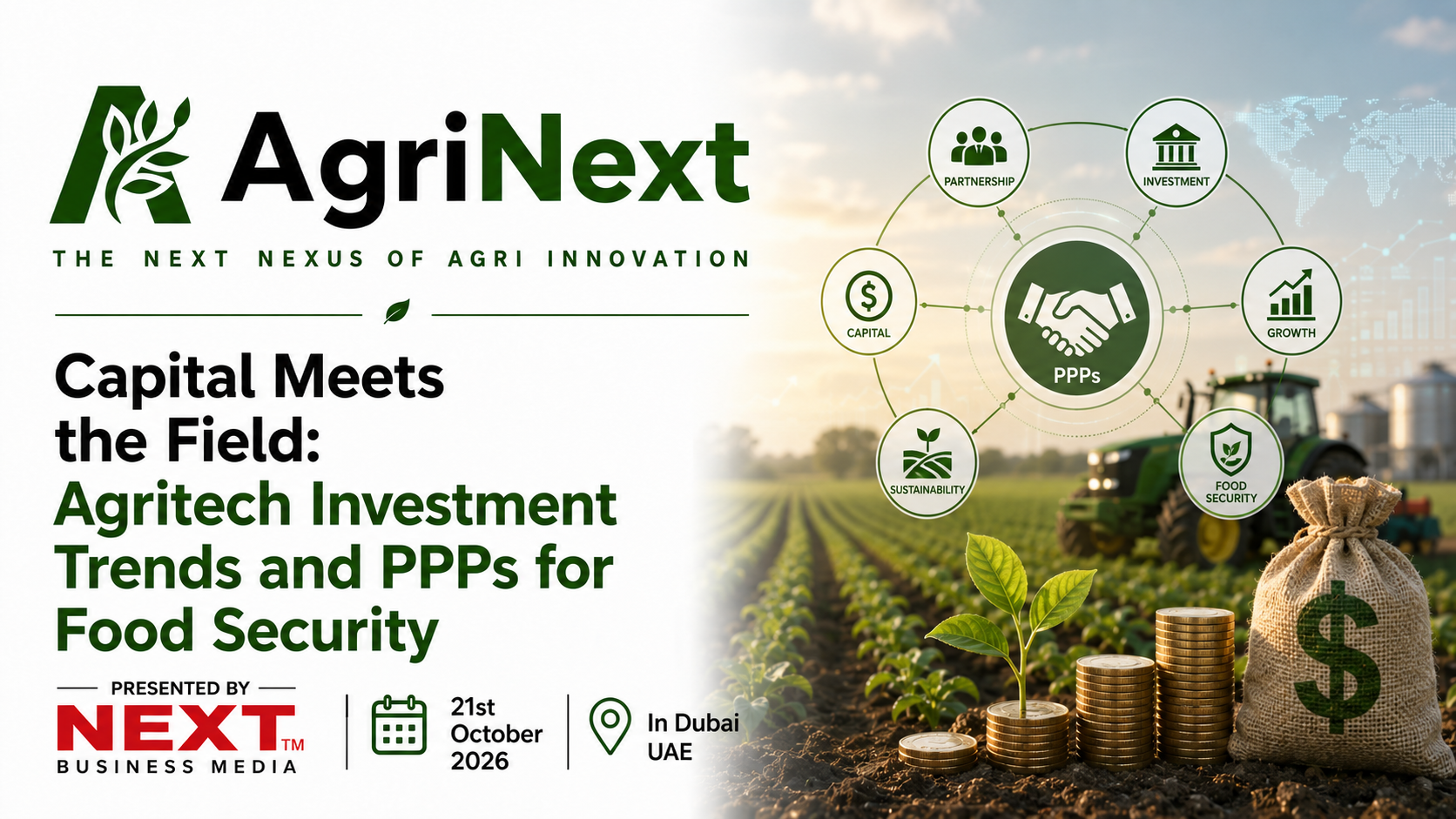
Global agrifoodtech funding has stabilized after several years of decline, but investors are deploying capital more selectively. Rather than chasing rapid growth, they are prioritizing technologies with strong scientific foundations, clear unit economics, and measurable improvements in farm productivity and climate resilience. At the same time, public–private partnerships (PPPs) are emerging as a key mechanism for scaling these innovations into resilient food systems, particularly in water-scarce and import-dependent regions such as the Middle East and Africa.
Agritech Investment Shifts Upstream
According to AgFunder’s Global Agrifoodtech Investment Report 2026, global agrifoodtech investment reached $16.2 billion in 2025, remaining broadly flat year over year. The biggest shift was toward upstream technologies operating at or before the farm gate.
Investment in farms, agricultural inputs, and biological systems climbed to $9 billion, up 7% year over year, while downstream sectors such as e-grocery and food delivery continued to cool. Investors increasingly favored technologies capable of delivering measurable yield improvements, lower input costs, and greater resilience to climate risks.
The strongest-performing categories included bioenergy and biomaterials, agricultural biotechnology, and farm management, sensing, and IoT. AI-powered precision agriculture, climate-resilient crops, biostimulants, biopesticides, and soil microbiome solutions also continued attracting significant investment.
Regional Momentum Broadens
The United States remained the largest agrifoodtech investment market in 2025 despite an 8% decline. India and China retained second and third positions globally, while the Netherlands moved into fourth place with a 44% increase in funding. Africa also recorded strong momentum, with investment rising 30% to $260 million, driven largely by agri-marketplaces, fintech, and digital food platforms.
Another notable trend was capital diversification. Nearly 46% of global investment went to first-time funded companies, while debt financing expanded to about 18% of total funding, reflecting growing confidence in scaling proven business models.
Investment Trends in Action
Recent funding rounds illustrate where investors see long-term value. UK-based Tropic Biosciences raised $105 million to accelerate gene-edited, climate-resilient crops, including coffee and banana varieties. In India, Resurrect Bio secured $8.1 million in Series A funding to expand biological seed treatment and crop protection technologies that reduce dependence on conventional chemicals.
Beyond individual funding rounds, investors continue backing farm management, sensing, and IoT platforms that combine satellite imagery, soil sensors, and AI to optimize irrigation, fertilizer use, and pest management. Africa’s agrifoodtech ecosystem is also gaining momentum, with investment growth driven by digital marketplaces and agrifintech platforms that improve farmers’ access to finance, agricultural inputs, and buyers—strengthening the foundations of food security.
Public–Private Partnerships Drive Agritech Adoption
While private investment identifies promising technologies, public–private partnerships (PPPs) help scale them into real-world impact. By bringing together governments, investors, research institutions, agribusinesses, and development organizations, PPPs accelerate research, strengthen infrastructure, reduce investment risk, and expand access to innovative farming solutions.
Across the world, PPPs are supporting climate-smart agriculture, digital farming, resilient supply chains, and sustainable food production. Key areas of collaboration include:
Research and innovation: Joint funding for agricultural R&D, biotechnology, and precision farming technologies.
Infrastructure development: Investments in irrigation, digital connectivity, cold-chain logistics, and rural innovation hubs.
Finance and technology adoption: Grants, blended finance, and technical support that help startups and farmers adopt sustainable agricultural solutions.
Successful PPPs are built on clear objectives, defined partner roles, and measurable outcomes for productivity, resilience, and food security. For example, PPPs have scaled biofortified crops in southern Africa and supported digital market platforms under APEC frameworks. Initiatives led by organizations such as the FAO, APEC, national governments, and development partners demonstrate how collaboration can accelerate agritech adoption while improving market access, strengthening supply chains, and supporting smallholder farmers.
As agritech investment increasingly focuses on measurable impact, effective public–private partnerships will be essential for transforming innovation into resilient, sustainable food systems.
AgriNext Awards & Conference Dubai 2026
The operationalization of these partnership models will be a core focus of the AgriNext Awards & Conference Dubai 2026. The summit brings together international policymakers, venture capitalists, and agritech pioneers to build resilient food systems across the GCC and MENA regions.
Key Focus Areas
Next-Gen Production: Deploying AI-driven precision farming, biological inputs, and controlled-environment agriculture (CEA).
Resource Management: Implementing IoT-enabled smart irrigation systems.
Capital Allocation: Analyzing agritech investment trends that prioritize measurable ESG impact.
Cross-Sector Frameworks: Structuring next-generation PPPs to accelerate regional food self-sufficiency.
Signup For AgriNext Conference Newsletter


 Reach us on WhatsApp