Agriculture is under growing pressure to produce more food with less water, energy, and land while adapting to rising temperatures. In the UAE and across the Middle East, climate-smart agriculture is emerging as a practical approach to reduce emissions, strengthen food security, and improve resilience.
Climate-smart farming combines emissions reduction, climate adaptation, and agricultural productivity. Its key solutions include climate-resilient crops, precision irrigation, renewable energy, artificial intelligence, controlled-environment agriculture, and circular waste management.
Climate-Smart Crops for the UAE
The UAE’s National Agricultural Initiative for the Adoption of Climate-Smart Crops, launched by the Ministry of Climate Change and Environment in partnership with the International Centre for Biosaline Agriculture, is an important development.
The program is testing foxtail millet, proso millet, sorghum, and blue panicum—crops selected for their ability to withstand heat, drought, and salinity. Some of these crops can use up to 50% less water than traditional grains, according to the program, while supporting food and livestock-feed production.
The initiative includes 45 field trials, training for 45 farmers, and capacity-building for agricultural extension officers. Its next phase is expected to focus on commercial expansion and private-sector partnerships.
This approach links climate adaptation with food security by helping diversify the UAE’s agricultural production and reduce dependence on imported crops.
Making Water and Energy More Efficient
Water efficiency is central to sustainable agriculture in the Gulf. AI-powered irrigation, soil-moisture sensors, satellite imagery, and weather analytics can enable farmers to apply water and fertilizer more precisely.
These technologies can reduce over-irrigation, lower pumping costs, minimize input waste, and support more efficient production. Renewable energy can further reduce emissions by powering irrigation, cooling, water treatment, and other farm operations.
Controlled-environment agriculture also offers potential resource advantages. Vertical farms, hydroponic systems, and aquaponics can recirculate water, control growing conditions, and produce crops closer to urban consumers.
Dubai’s Bustanica illustrates the potential of this model. The vertical farm produces leafy greens for the local market and has been reported to use approximately 95% less water than conventional agriculture. However, its overall carbon performance depends on factors including the energy used for lighting, cooling, and climate control. Vertical farming should therefore not automatically be described as carbon neutral.
Building Circular Food Systems
Dubai’s emerging GigaFarm offers another example of climate-smart agriculture.
The project, being developed by ReFarm Global and Intelligent Growth Solutions, covers approximately 900,000 square feet and is planned to include 200 vertical farming towers. According to the project developers, it is designed to produce more than three million kilograms of food annually while diverting more than 50,000 tones of food waste from landfill through waste-to-value and regenerative technologies.
By combining food production with waste-to-value technologies, the project aims to create a more circular system in which organic waste can become a useful agricultural input rather than a disposal burden.
Measuring Real Impact
The success of climate-smart agriculture will depend on how effectively its environmental and economic impacts are measured. A project should not be labelled low-carbon or carbon neutral simply because it uses solar panels, sensors, or vertical growing systems.
Farmers, investors, policymakers, and buyers should assess:
• Greenhouse gas emissions per unit of food produced
• Water consumption per kilogram of crop
• Energy use and the source of electricity
• Fertilizer and pesticide efficiency
• Soil-carbon changes where relevant
• Food waste avoided or diverted
• Crop yields and farmer profitability
• Resilience to heat, drought, and salinity
• The permanence and verification of carbon claims
This measurement-based approach can help distinguish measurable environmental progress from unsupported sustainability claims.
AgriNext Awards &Conference and the Green Transition
The UAE’s climate-smart crops initiative, Dubai’s vertical-farming expansion, AI-enabled irrigation, and circular food-production projects show how agriculture in the region is evolving.
The next generation of farming will not depend on one technology. It will emerge from the integration of resilient crops, precision agriculture, renewable energy, controlled environments, circular waste management, and evidence-based carbon accounting.
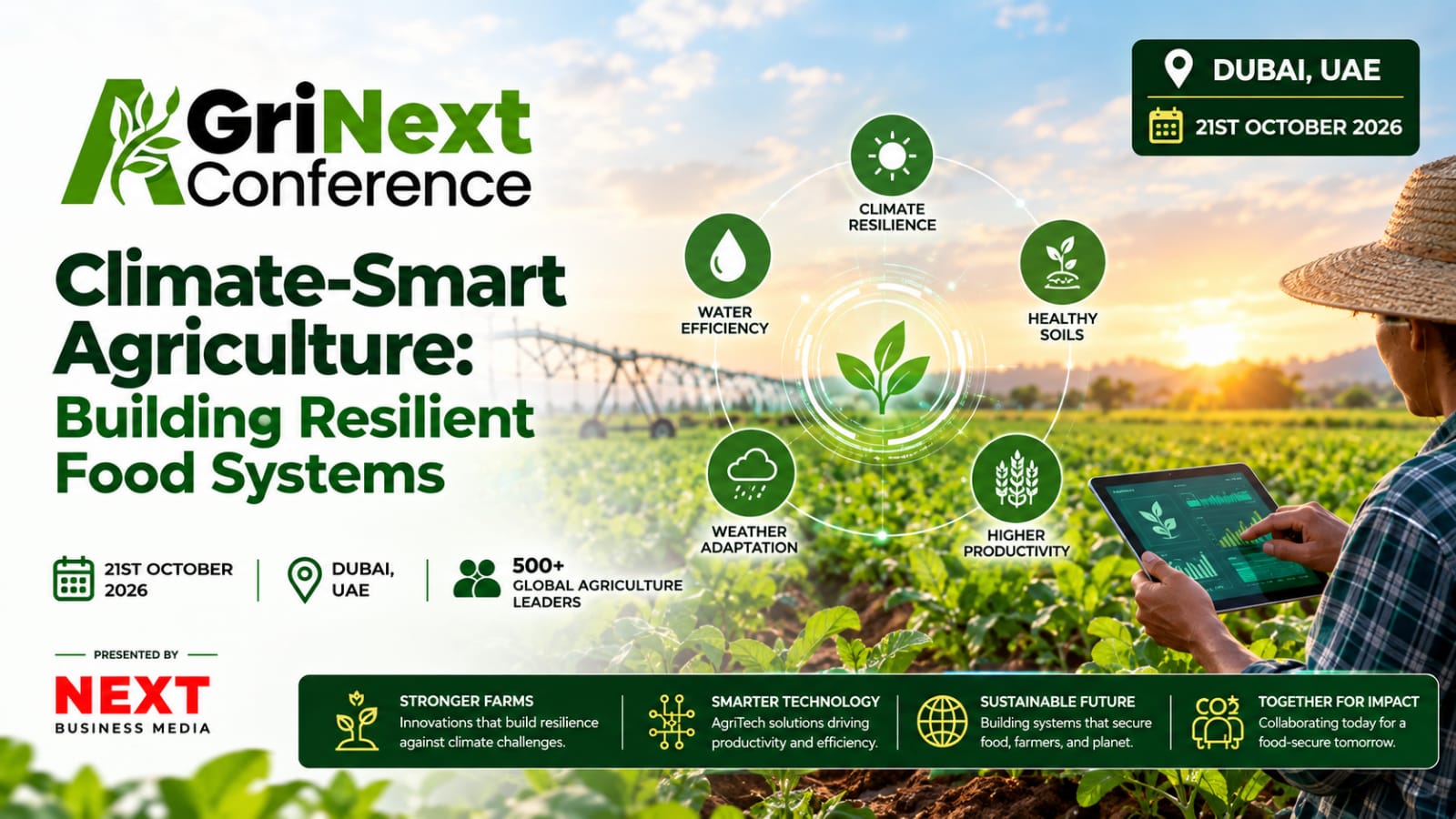
AgriNext Awards & Conference Dubai 2026 provides an opportunity for farmers, technology providers, investors, researchers, policymakers, and food-system leaders to examine how these solutions can move from pilot projects to commercially viable models.
For the Middle East, the goal is not simply to produce food with fewer emissions. It is to build food systems that can remain productive, profitable, and resource-efficient in a hotter and more water-constrained future.