
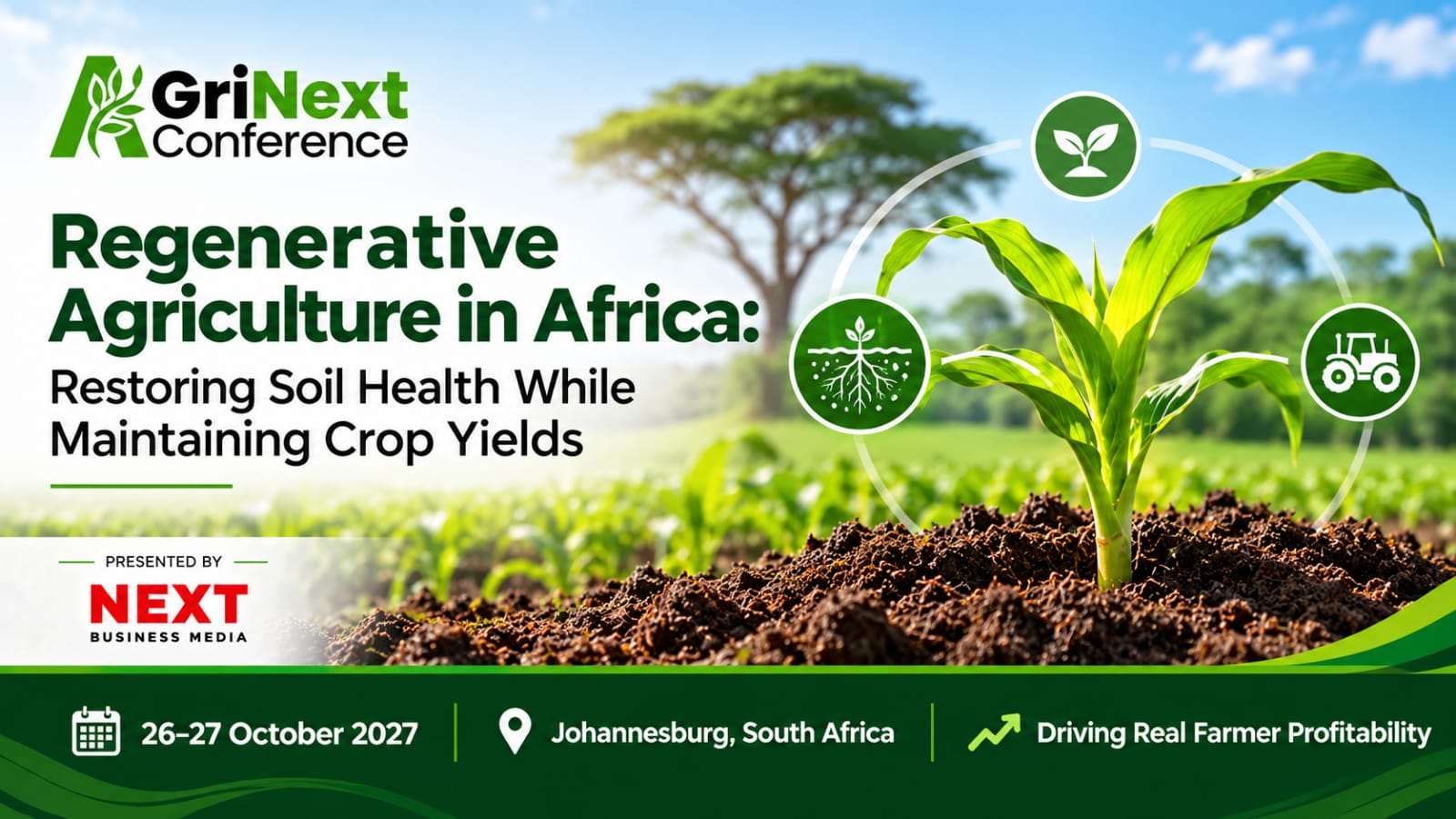
Africa’s farms face a difficult equation: soils are degrading, rainfall is becoming less predictable, and farmers must produce more food without locking themselves into rising fertilizer and irrigation costs. Regenerative agriculture offers a practical path forward—rebuilding soil health while protecting, and often improving, crop yields.
Why soil health is the starting point
Healthy soil does more than hold a crop in place. It stores water, cycles nutrients, supports beneficial microbes, reduces erosion, and helps crops survive dry spells. When soil organic matter declines, farmers often respond with more inputs—but degraded soils cannot use those inputs efficiently.
Regenerative agriculture focuses on restoring the biological and physical functions of soil through practices such as:
• Cover cropping and mulching to keep soil protected
• Crop rotation and intercropping to improve nutrient cycling and pest control
• Reduced or minimum tillage to preserve soil structure
• Agroforestry and shade trees to improve water infiltration and reduce runoff
• Compost, manure, and legumes to rebuild organic matter and fertility
• Controlled integration of livestock to return nutrients to the land
These practices are not about abandoning productivity. They are about making productivity more stable over time.
The yield question farmers rightly ask
The most common concern is straightforward: Will crop yields fall while the soil recovers?
The answer depends on the crop, rainfall patterns, soil conditions and how regenerative practices are implemented. However, evidence from African programs suggests that regenerative agriculture can improve yields while strengthening resilience.
Business-led regenerative agriculture programs in Sub-Saharan Africa have reported yield increases ranging from 68% to 300% across initiatives reaching more than 100,000 farmers. These results vary by program and farming context. Separately, modelling cited by IUCN projects a conservative 13% yield increase by 2040 if regenerative agriculture is implemented at scale, while some studies suggest potential gains of up to 40%.
The important point is that regenerative agriculture works best as a combination of practices rather than a single intervention. Mulching can help conserve moisture, but combining it with legumes, reduced tillage and appropriate nutrient management can deliver broader benefits.
Agroforestry and maize in Malawi
Malawi provides a relevant example of how climate-smart agroforestry can support smallholder farming. Integrating trees and shrubs into agricultural landscapes can improve soil protection, reduce erosion and help farming systems manage changing rainfall conditions.
Trees planted within or around cropping systems can reduce surface runoff, improve water infiltration, add organic matter and create more favorable growing conditions.
A meta-analysis published in Agriculture, Ecosystems & Environment found that agroforestry reduced runoff by 57% compared with monoculture and increased water infiltration rates by 75% in the humid and sub-humid tropics. These findings highlight the potential of agroforestry to improve soil and water management, although results vary by location and farming system.
For maize farmers, locally adapted agroforestry systems can contribute to:
•More water available during dry periods
•Less topsoil loss during heavy rainfall
•Better nutrient retention around crop roots
•Improved long-term soil structure and biological activity
The lesson is not that every farmer should plant the same trees. Locally suitable agroforestry systems can help turn vulnerable fields into more resilient production systems.
What works for smallholders
For smallholder farmers, the best starting points are often affordable practices that can deliver visible benefits within one or two growing seasons.
Mulching: Retain crop residues, grass or leaf litter to reduce evaporation and erosion. Conservation Agriculture guidance commonly uses at least 30% soil cover from crop residues or cover crops as a benchmark.
Legume integration: Grow beans, cowpeas, groundnuts or green-manure crops to improve nitrogen availability and diversify farm income.
Compost and manure: Use locally available organic materials to rebuild soil organic matter, particularly when combined with targeted mineral fertilizer where soils are severely depleted.
Intercropping: Combine cereals with legumes to improve land-use efficiency, diversify production and help manage pest pressure.
Contour bunds and water harvesting: Slow surface runoff on sloping land and retain more water within agricultural fields.
Importantly, regenerative agriculture should not be presented as a zero-external-input approach. In many parts of Sub-Saharan Africa, soils are severely nutrient-depleted, and organic materials alone may not close existing yield gaps.
A more practical approach is integrated soil fertility management, combining organic inputs that improve soil structure and biological activity with the appropriate amount and placement of mineral fertilizers.
The transition challenge
The first seasons can be challenging. Farmers may face additional labor requirements for mulching or composting, increased weed pressure under reduced tillage, or uncertainty while adapting their farming systems.
A South African regenerative agriculture trial, for example, reported improvements in soil-health indicators but lower wheat yields in the early stages. The findings highlight the importance of nutrient management, weed control, technical guidance and realistic expectations during the transition.
Scaling regenerative agriculture therefore requires more than promoting individual techniques. It needs farmer-led demonstration plots, local advisory services, access to quality seeds and organic inputs, and financial or market mechanisms that reward farmers for improving soil health.
AgriNext Awards and Conference Africa 2027
As African agriculture explores more resilient and productive farming systems, regenerative agriculture will remain an important part of the discussion. AgriNext Africa 2027 will bring together agricultural leaders, farmers, investors and innovators to explore sustainable farming, soil health, climate resilience and the future of food production across the continent.
Join the conversation on building a more productive and resilient agricultural sector in Africa.
Register now agrinextcon.com