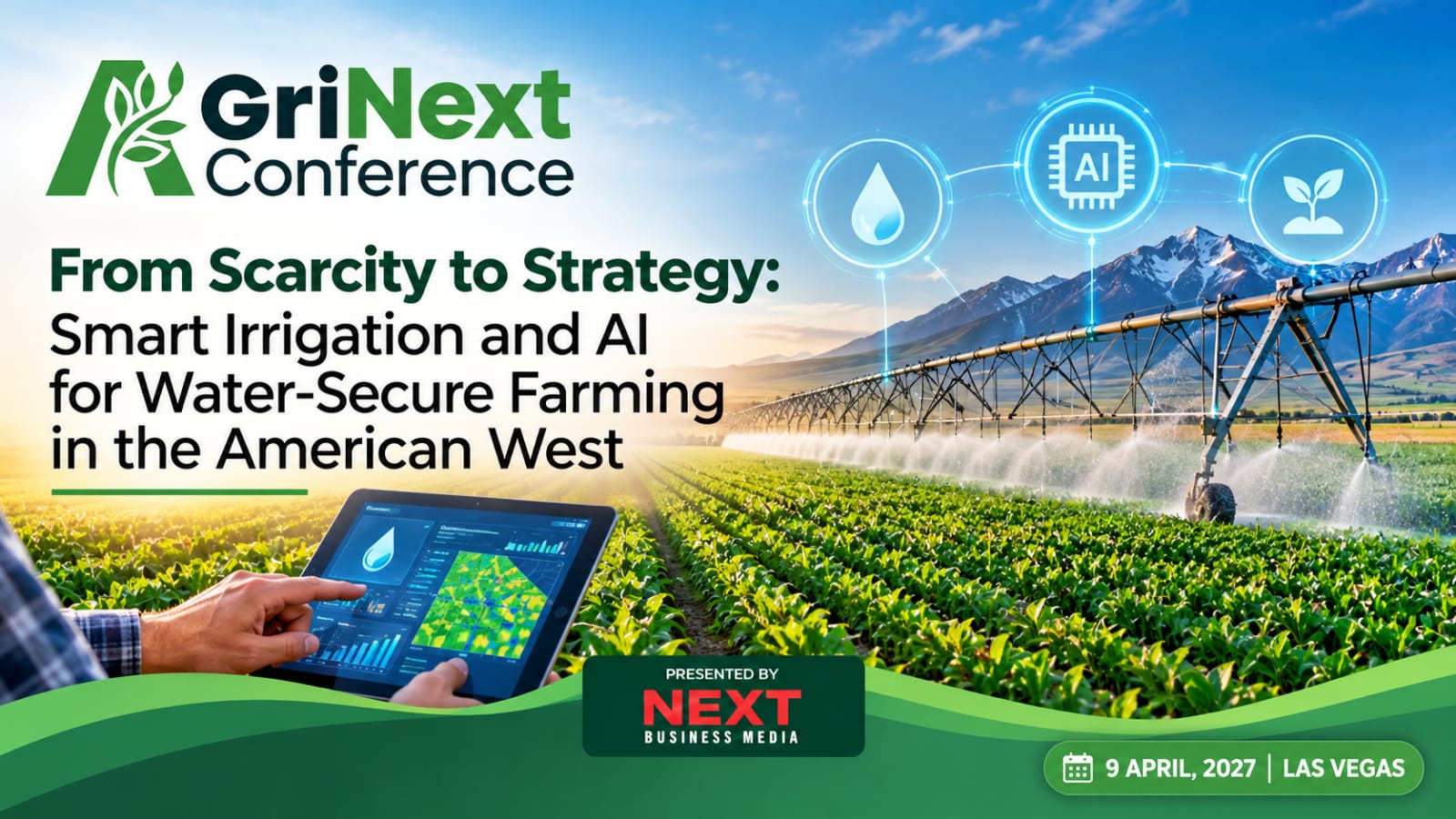
Water scarcity in the American West is no longer an occasional drought problem—it is a structural challenge reshaping how farms plan, invest, and grow. The solution is not simply to use less water, but to manage every acre-foot strategically through sensors, automation, and AI-driven decision-making.
The New Water Reality
Across California, Arizona, Colorado, and the Pacific Northwest, growers face shrinking surface-water allocations, depleted aquifers, rising pumping costs, and increasingly unpredictable weather. In California’s San Joaquin Valley, for example, some producers have had to operate with only a fraction of their normal federal Central Valley Project allocation, forcing difficult choices about which crops to irrigate and which fields to follow.
Traditional irrigation schedules—based on calendars, habit, or broad field averages—leave too much value on the table. Smart irrigation replaces guesswork with real-time evidence: soil moisture, crop water stress, weather forecasts, evapotranspiration, and pump-energy data can be combined to determine exactly when, where, and how much to irrigate.
What Smart Irrigation Looks Like
A modern smart-irrigation system typically includes:
• Soil-moisture probes placed at multiple root-zone depths.
• Weather stations and satellite or drone imagery to estimate crop demand.
• Automated valves, pumps, and drip or micro-sprinkler systems.
• Cloud dashboards that turn field data into practical irrigation recommendations.
• AI models that learn from each irrigation cycle and improve future decisions.
The goal is crop per drop: maintaining yield and quality while avoiding overwatering, deep percolation losses, runoff, and unnecessary energy use.
California Almonds
California almond orchards offer a powerful example of what is possible. Researchers at the University of California, Merced, and the University of California Agriculture and Natural Resources developed an AI-powered irrigation system for an almond orchard at the Kearney Agricultural Research and Extension Center in Parlier. The system uses soil-moisture measurements and data on how water moves through trees to help determine when sprinklers should operate and how long they should run. An AI algorithm processes the field data and controls the sprinklers, allowing researchers to compare its performance with traditional irrigation methods. The project demonstrates how AI can support more precise water management in California almond production.
The results from broader precision-irrigation projects reinforce the opportunity. In California’s South San Joaquin Irrigation District, an automated pressurized delivery system serving 3,800 acres conserved 12,000 acre-feet of water annually, reduced on-farm water use by 30%, increased crop yields by 30%, and cut irrigation costs by 50%.
AI Turns Data Into Decisions
Sensors alone cannot solve water scarcity; they generate the data needed to make better decisions. AI turns that data into practical irrigation strategies by analyzing soil conditions, weather patterns, crop growth stages, and historical irrigation performance.
With these insights, growers can make more informed decisions:
Predict crop water stress: Identify areas where crops may experience water stress before visible symptoms appear.
Improve irrigation timing: Determine whether irrigation can be delayed without affecting crop health, yield, or quality.
Detect uneven water distribution: Identify areas receiving too much or too little water and adjust delivery accordingly.
Reduce pumping costs: Schedule irrigation during off-peak electricity hours where water availability and farm infrastructure allow.
Allocate limited water: Prioritize fields and crops based on growth stages, water requirements, and expected economic returns during drought conditions.
A practical example comes from California's Terranova Ranch, where LoRaWAN-connected technology and automated irrigation management have improved water-use efficiency. In a 400-acre processing tomato pilot, the farm achieved a 34% reduction in water use, saving 136 acre-feet of groundwater and approximately $22,420 in annual water costs. The project also generated more than $61,000 in total first-year operational savings through reduced labor, vehicle use, and other operating expenses. These results demonstrate how connected irrigation systems can improve water management while supporting farm profitability.
From Farm-Level Savings to Regional Resilience
Smart irrigation benefits extend beyond a single field. Reduced groundwater pumping helps stabilize aquifers. More accurate water delivery reduces nutrient runoff and protects water quality. Lower energy demand supports both farm profitability and grid reliability. And when thousands of growers adopt data-driven scheduling, the cumulative effect becomes a regional water-security strategy.
The American West does not need a single miracle technology. It needs connected systems: efficient hardware, reliable connectivity, transparent data, grower-friendly software, and AI that supports—not replaces—farmer judgment.
Join the Conversation at AgriNext US
Join us at AgriNext Awards & Conference US in Las Vegas on 9 April 2027 to explore how AI, automation, and precision irrigation can turn water scarcity into a competitive advantage. Connect with growers, AgTech innovators, researchers, and investors shaping the future of water-smart agriculture.
Register now: https://agrinextcon.com/register