
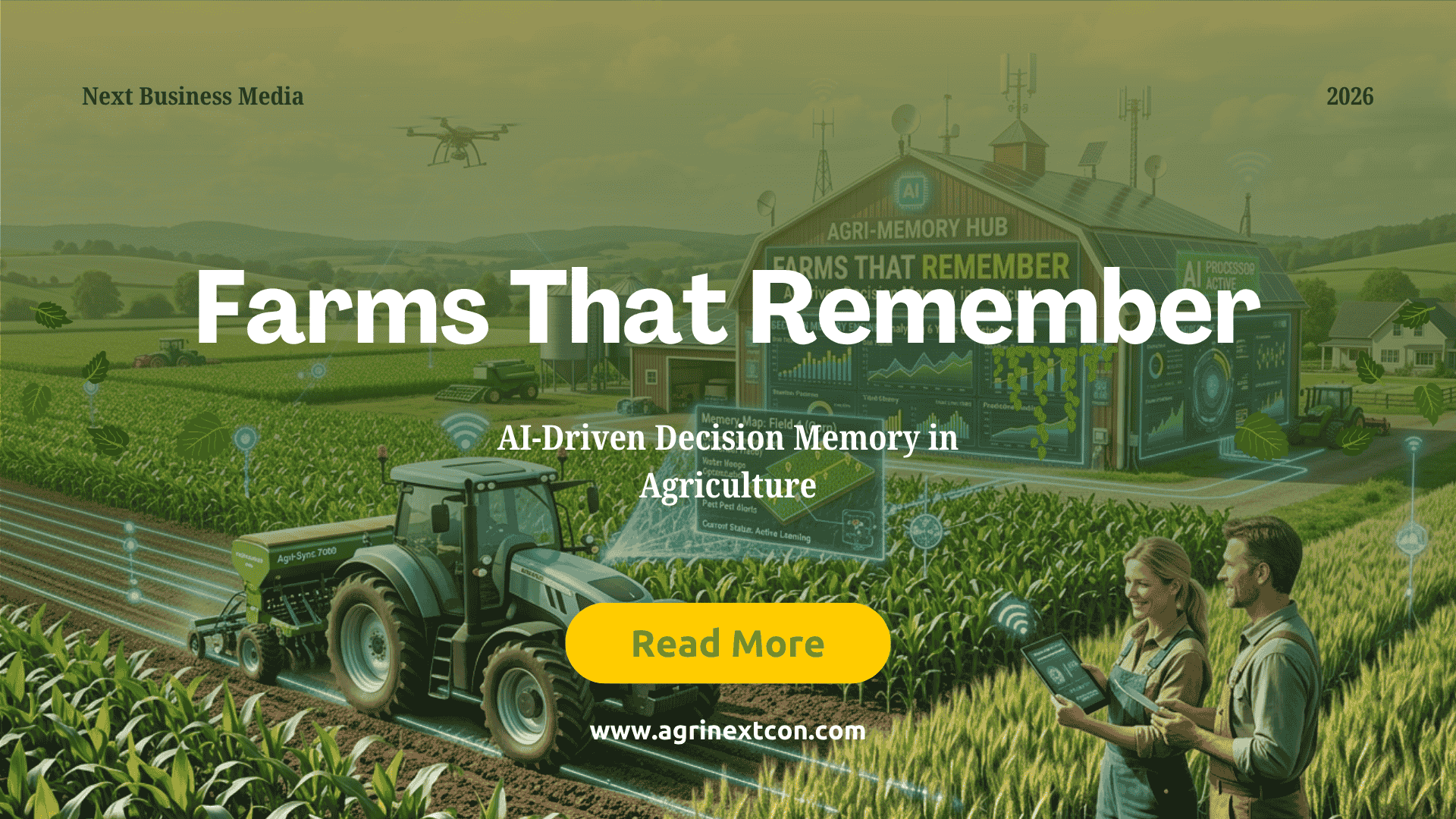
Modern agriculture often suffers from seasonal amnesia, where critical insights from past weather patterns, soil conditions, and pest cycles are lost in fragmented datasets. While farmers may recall major events like droughts or outbreaks, this knowledge is rarely captured in a structured, reusable way.
As farming becomes increasingly data-driven, the challenge is no longer collecting information—it’s ensuring farms can retain, interpret, and learn from it over time.
AI-powered decision-support systems are now evolving into memory-aware platforms. These systems integrate multi-season satellite imagery, in-field sensor data, and farmer observations to generate recommendations on sowing windows, fertiliser use, and yield optimisation—while continuously learning from past outcomes.
This introduces a powerful new layer: decision-memory. Instead of reacting season by season, farms begin to operate as learning systems—building intelligence with every cycle.
A growing application of this concept is the digital twin of the farm—a longitudinal model that records pest incidence, irrigation patterns, and market exposure across seasons. With this, farmers and agronomists can ask: What happened when planting was delayed in 2023?—and receive data-backed, context-aware answers derived from their own history.
Core Technology: Building Decision-Memory
Creating a farm that truly learns requires an integrated AI pipeline that connects past and present data streams.
First, soil-history classification uses deep learning models such as MobileNetV2 and ResNet to track long-term changes in soil texture, organic matter, and compaction.
Second, predictive yield modeling applies ensemble techniques like Random Forest and XGBoost to multi-year datasets of weather patterns, nutrient inputs, and crop performance—achieving accuracy levels exceeding 90% in controlled trials.
Finally, Explainable AI (XAI) tools such as SHAP and LIME translate complex predictions into clear, actionable insights. This ensures farmers understand not just what to do, but why—bridging the gap between advanced analytics and real-world agronomy.
Strategic Outcomes
When deployed systematically, AI‑Driven Decision‑Memory can transform farm operations from reactive and fragmented to proactive and adaptive. Farms gain a persistent institutional memory that preserves context across seasons, improves input‑use efficiency, and reduces environmental impact. For agricultural stakeholders—from smallholders to agribusinesses—this approach sets the foundation for scalable, data‑driven decision‑making that turns every harvest into a lesson for the next planting cycle.
At AgriNext 2026, the concept of AI‑Driven Decision‑Memory becomes more than a technical novelty—it becomes a practical pathway for transforming vulnerable, fragmented farming systems into adaptive, data‑aware enterprises.
By bringing together agronomists, AI developers, and agri‑tech startups, the event highlights how memory‑enabled platforms can turn fragmented farming into adaptive, data‑driven systems. From digital twins to explainable AI tools, the emphasis is on real‑world deployment, not theory. The takeaway is clear: farms that remember perform better. And platforms like AgriNext are accelerating this shift by connecting innovation with on‑the‑ground agricultural needs.
Signup For AgriNext Conference Newsletter


 Reach us on WhatsApp