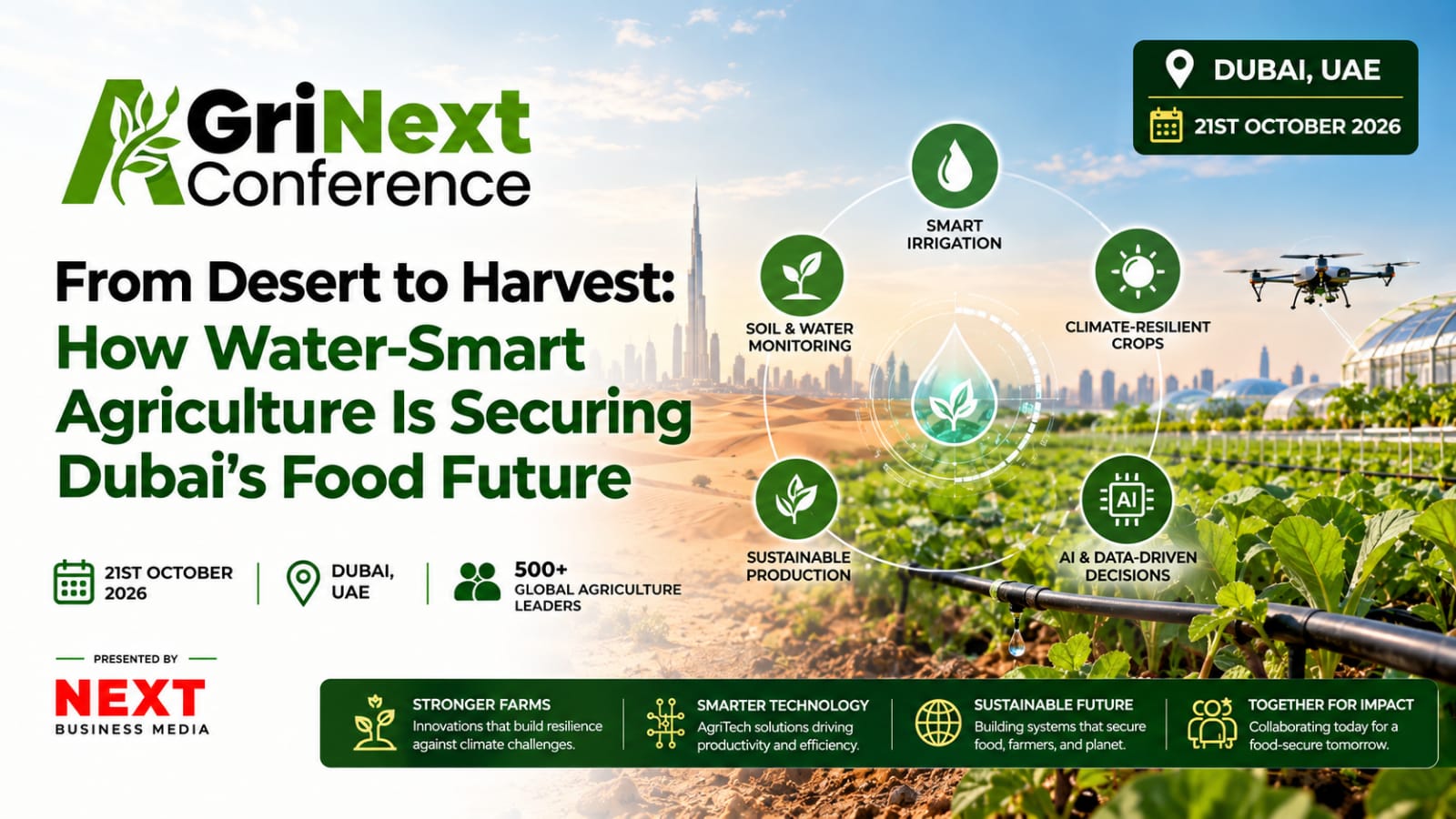
In a region where water is limited and temperatures are rising, the future of agriculture depends on producing more food with fewer resources. Dubai is responding to this challenge by adopting water-smart technologies that can improve productivity, reduce waste and strengthen food security.
The UAE’s National Food Security Strategy 2051 aims to strengthen access to safe, nutritious and sufficient food while building a more resilient food system. This ambition is encouraging farmers, technology providers, investors and policymakers to explore new approaches to food production.
Making every drop count
Traditional farming methods can be difficult to sustain in arid climates. High temperatures increase evaporation, while limited rainfall and groundwater supplies restrict agricultural expansion. Water-smart agriculture offers a more efficient alternative by using data, automation and controlled growing environments.
Smart irrigation systems use soil-moisture sensors, weather data and artificial intelligence to deliver water according to crop requirements. These systems can help reduce over-irrigation and allow farmers to identify changes in soil and plant conditions before they affect productivity. Connected technologies can also monitor temperature, humidity, nutrient levels and plant health in real time.
The result is a shift from fixed irrigation schedules to precision-based water management. Instead of watering an entire field equally, farmers can provide the appropriate amount of water to specific crops or growing zones.
The role of controlled environments
Hydroponics, aeroponics, greenhouses and vertical farms are also changing the agricultural landscape. These systems allow crops to grow in carefully managed environments, often without soil. Water can be collected, filtered and returned to the production cycle, reducing losses caused by runoff and evaporation.
A relevant example is Badia Farms in Dubai, which uses vertical-farming and hydroponic systems to grow fresh produce in a controlled indoor environment. Its approach demonstrates how local food production can use technology to manage water and growing conditions more efficiently.
Vertical farms can also bring production closer to consumers. This can shorten supply chains, support fresher deliveries and reduce some of the transport requirements associated with imported produce. For restaurants, hotels, retailers and food-service companies, locally grown leafy greens and herbs can offer both freshness and supply-chain resilience.
Innovation must be sustainable
Technology alone will not solve every agricultural challenge. Controlled-environment farms require electricity for cooling, lighting, pumping and climate management. If this energy comes from carbon-intensive sources, water savings may be offset by higher emissions.
For this reason, the next phase of AgriTech development must connect water efficiency with renewable energy and energy-efficient cooling, alongside responsible nutrient use and transparent measurement.
Farmers and investors need to evaluate the complete environmental and economic performance of each solution.
Questions around cost, scalability, maintenance, skills and crop selection are equally important. A technology that works in a pilot project must also be affordable, reliable and practical for commercial growers.
Collaboration can accelerate progress
Dubai’s agricultural future will depend on collaboration across the entire food system. Farmers understand production realities. Technology companies provide digital and engineering solutions. Researchers develop climate-resilient crops. Investors create opportunities for scale, while policymakers establish the conditions for responsible growth.
AgriNext Awards & Conference Dubai provides a platform for these stakeholders to exchange ideas, showcase solutions and build partnerships. The conversation is no longer limited to how much food can be produced. It must also consider how efficiently food is grown, how water and energy are managed, and how innovations can contribute to long-term food-system resilience.
The journey from desert to harvest will require practical innovation, measurable impact and shared commitment. By bringing together the people shaping the future of agriculture, AgriNext Dubai can help advance water-smart farming as a scalable pathway toward greater food security and resource efficiency.
Discover the technologies, ideas and partnerships shaping the future of agriculture at AgriNext Awards and Conference Dubai. Connect with agriculture leaders, innovators, investors and policymakers working to build more resilient, efficient and sustainable food systems.