
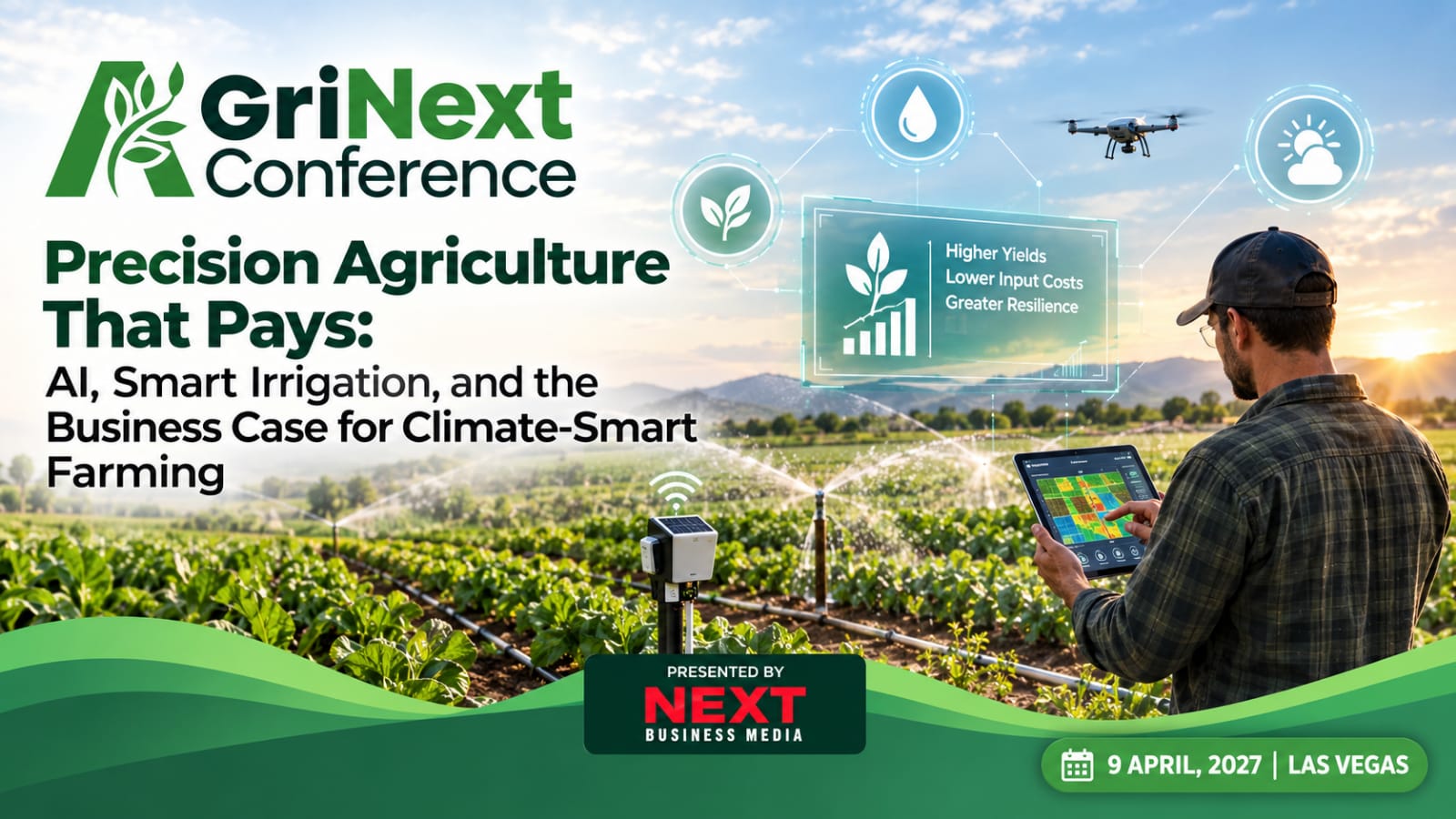
Precision agriculture is becoming a practical way to improve farm economics. As water scarcity, input costs, labor shortages, and climate volatility increase, farmers need technologies that deliver measurable returns rather than another dashboard or disconnected data tool.
The central question is simple: Can AI and smart irrigation make climate-smart farming profitable at scale? Evidence from real-world field projects suggests they can, particularly when technologies help farmers reduce input use and make better decisions.
From data to decisions
Modern farms generate information from soil sensors, weather stations, drones, satellites, irrigation controllers, and machinery. But data alone does not improve profitability.
The real value comes when AI and digital tools turn that information into actionable decisions: when to irrigate, how much water to apply, where weeds are emerging, which zones need fertilizer, and where yield risks are increasing. Precision agriculture delivers value when it helps farmers act earlier, use inputs more efficiently, and avoid unnecessary costs.
Smart irrigation: a practical business case
Water management is one area where precision agriculture can deliver measurable benefits. The Nebraska Agricultural Water Management Network provides an example of how soil-moisture monitoring and improved irrigation scheduling can support more efficient water use.
Established in 2005, the network grew from a small group of participating growers to more than 1,400 participants. Early reports indicated that farmers using soil-moisture sensors and crop water-use information reduced irrigation by an average of approximately 1–3 inches, depending on the farm and conditions.
These results demonstrate how better irrigation decisions can reduce water and pumping requirements. For farmers, the financial benefits can include lower energy costs and more efficient use of available water. However, the actual savings depend on local conditions, equipment costs, crop requirements, and existing irrigation practices.
The business case is therefore not simply about installing sensors. It is about using reliable information to make better decisions throughout the growing season.
AI-guided spraying: reducing input costs
AI-enabled precision spraying offers another example of how technology can improve farm economics.
In a 2024 field-scale demonstration, Iowa State University researchers evaluated John Deere's See & Spray Ultimate system across five soybean fields covering 415 acres. The trial recorded herbicide product savings ranging from 43.9% to 90.6%, with an average reduction of 76%. The estimated savings from reduced herbicide use totaled nearly $6,500, or approximately $15.70 per acre.
The results show how camera-based detection and targeted spraying can reduce chemical use by applying herbicides where weeds are detected rather than treating the entire field uniformly.
However, savings varied with weed pressure and field conditions. Farmers must also consider equipment costs, maintenance, operating requirements, and the suitability of the technology for their crops and farming systems.
The broader lesson is that precision technology can create measurable value when its benefits are evaluated against the costs of adoption.
Climate-smart farming needs sound economics
Climate-smart agriculture cannot rely on environmental goals alone. It must also address farm cash flow, upfront technology costs, seasonal risks, labor availability, financing, and the need for reliable yields.
The most effective precision-agriculture solutions will be those that:
• Reduce water, fertilizer, fuel, or crop-protection costs.
• Protect or improve yields under variable weather conditions.
• Save labor through automation and better decision-making.
• Demonstrate a realistic payback period.
• Perform reliably under real field conditions, not only in controlled trials.
Sustainability becomes easier to scale when environmental benefits align with farmers' economic needs.
The road ahead
The next stage of precision agriculture will depend less on the number of sensors deployed and more on the outcomes these technologies deliver. Farmers, agribusinesses, lenders, and investors will increasingly need evidence of returns across different crops, soil types, farm sizes, and climate conditions.
AI, smart irrigation, robotics, and data-driven agronomy can help make farming more efficient and resilient. Their long-term success, however, will depend on practical implementation, transparent measurement, and business models that work for the people operating farms.
Join the conversation at AgriNext Las Vegas
AgriNext Awards & Conference Las Vegas 2027 will bring together growers, agritech innovators, investors, researchers, and policymakers to discuss the technologies and strategies shaping modern agriculture.
Explore how precision agriculture, AI, and smarter resource management can support more productive and climate-resilient farming.
Register for AgriNext Las Vegas 2027: https://agrinextcon.com