Regenerative agriculture is moving beyond pilot projects toward programmatic scale across the U.S. Midwest. The shift is being driven by a combination of agronomic evidence, supply-chain incentives, conservation programs, and emerging environmental markets.
Why the Midwest Matters
More than a century of intensive row-crop production has affected soil health and organic carbon levels across many Midwest agricultural landscapes. Recent research, however, shows that practices such as perennial vegetation, cover crops, and diversified rotations can help rebuild soil health while delivering wider environmental benefits.
At the same time, major agricultural buyers are creating financial incentives for farmers to adopt regenerative practices within their supply chains. ADM’s re:generations program, for example, provides per-acre incentives for practices including cover crops, nutrient management, and reduced tillage.
The Ecosystem Services Market Consortium’s Eco-Harvest program similarly rewards farmers for practices such as cover cropping, reduced tillage, and improved nutrient management through an environmental market framework.
These initiatives are moving beyond the experimental stage. Cargill’s RegenConnect surpassed one million enrolled acres for the 2025 U.S. planting season. Farmers for Soil Health has increased its cover-crop payment to $35 per acre per year for eligible acres, while Practical Farmers of Iowa’s 2026 cost-share program offers up to $15 per acre for fall-seeded cover crops across six Midwest states.
Ducks Unlimited’s Midwest Cover Crop Initiative, supported by ADM and FBN, targets 320,000 acres across Indiana, Michigan, and Ohio, with payments of $10–$25 per acre.
Together, these programs illustrate an important shift: regenerative agriculture is increasingly being supported through structured financial mechanisms rather than relying solely on farmers to absorb the cost and risk of adoption.
Prairie Strips in Iowa
Prairie strips demonstrate how a relatively simple conservation practice can deliver multiple benefits.
More than 15 years of research in Iowa has examined how native perennial vegetation placed along field edges and within fields can support pollinators while improving broader conservation outcomes.
Iowa State University’s research summary highlights the role of prairie strips in providing habitat and food resources for pollinators.
Landowners can also enroll in USDA’s prairie-strip conservation practice, CP-43, which is designed to reduce soil erosion, intercept nutrients, and provide wildlife habitat.
Research comparing prairie strips with conventional grassy vegetation strips has found higher monarch densities in prairie strips, along with habitat benefits for wild bees.
The broader lesson is significant. Practices with measurable environmental benefits can become more scalable when they are supported by cost-share programs, technical assistance, standardized conservation practices, and straightforward enrollment pathways.
Building the Technology and Verification Stack
Scaling regenerative agriculture also requires credible measurement and verification.
As sustainability claims become more closely scrutinized, programs increasingly need reliable data on field boundaries, management practices, soil conditions, and environmental outcomes. Soil sampling, remote sensing, farm-management data, and third-party verification can help create a more transparent evidence base for sustainability and environmental-market claims.
Data platforms such as Gradable can help aggregate farm and practice data, support measurement and modeling, and prepare documentation for buyers and verification processes.
For AgTech companies, this creates an important opportunity: simplifying the entire workflow, from field mapping and practice documentation to soil-sample scheduling, data management, verification, and reporting.
The technology challenge is therefore not simply collecting more data. It is turning fragmented farm-level information into consistent, auditable, and decision-ready evidence.
From Regenerative Practices to Scalable Markets
The Midwest provides a useful test case for how regenerative agriculture can move from individual farm experiments toward large-scale adoption.
Cover crops can improve soil protection and nutrient management. Prairie strips can combine conservation with biodiversity benefits. Supply-chain programs can help offset adoption costs. Environmental markets can create additional economic incentives. And digital verification systems can provide the data infrastructure needed to support credible claims.
Join the conversation at AgriNext Las Vegas
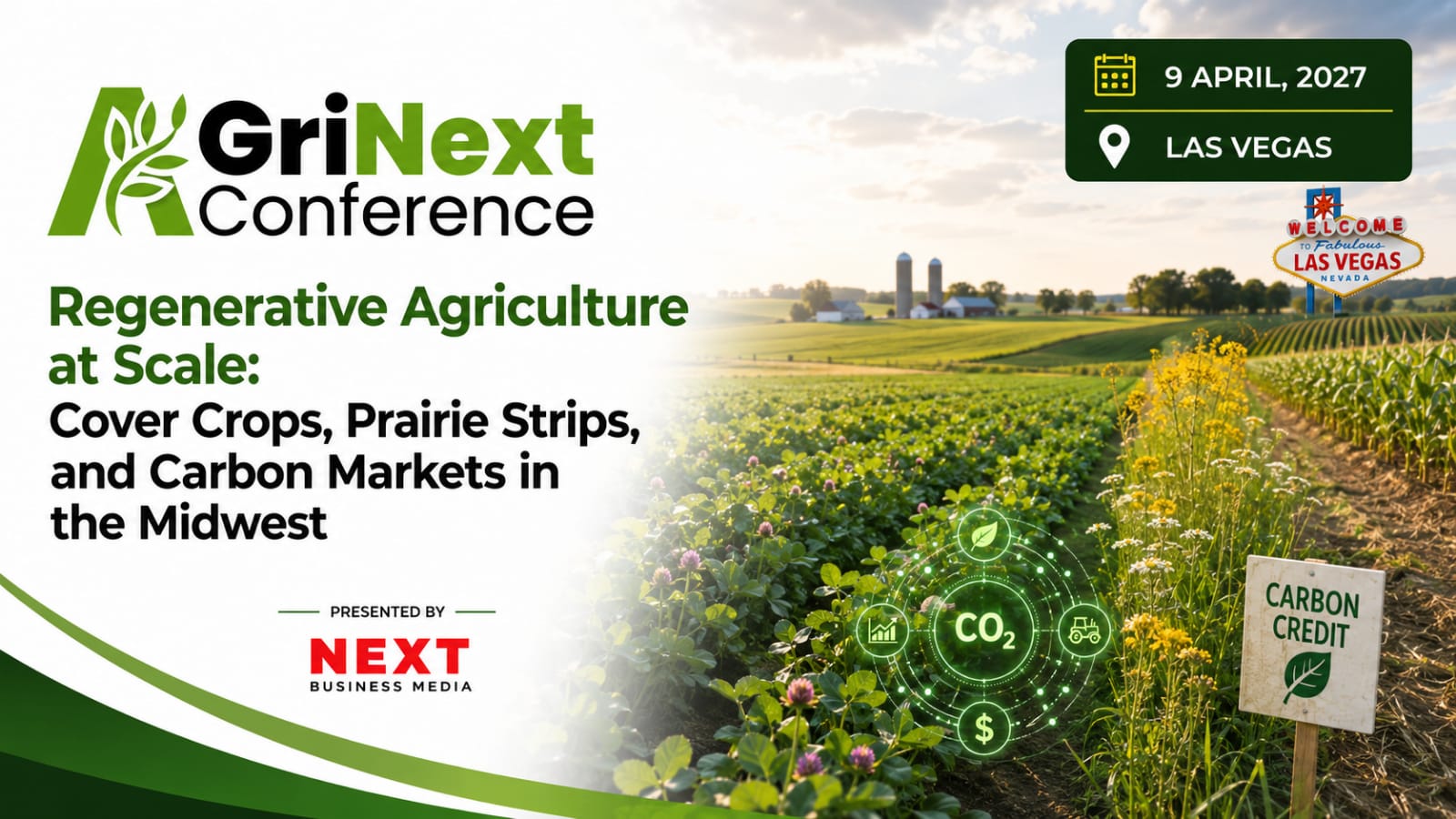
AgriNext Awards & Conference Las Vegas 2027 will bring together agriculture leaders, AgTech innovators, investors and policymakers to explore practical pathways for scaling climate-smart and regenerative agriculture. Discussions will focus on soil health, regenerative practices, carbon markets and supply-chain decarbonization, while examining how field evidence, financial incentives and verification technologies can help transform individual projects into durable, scalable and bankable programs.