
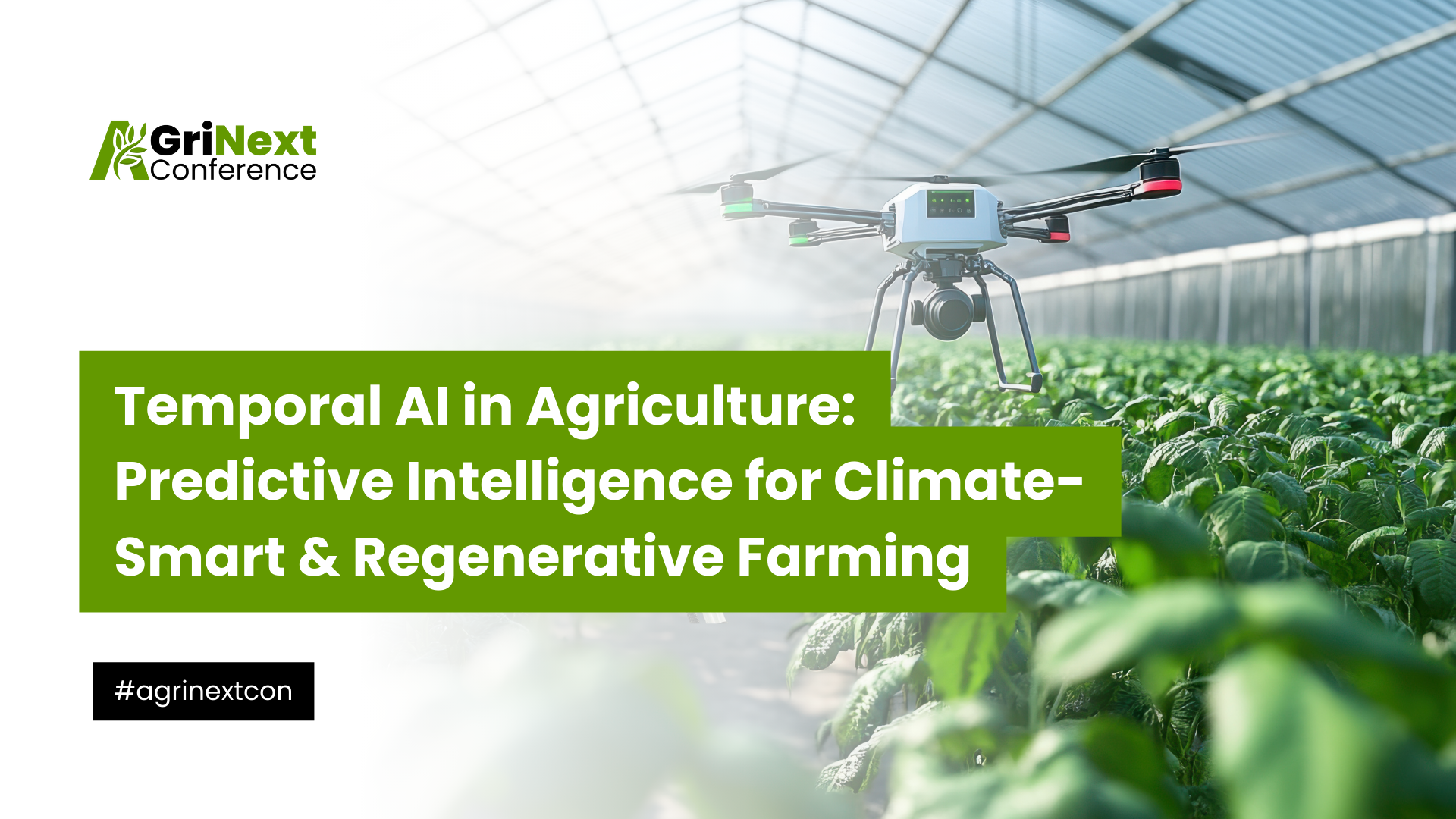
Agriculture has always been shaped by time—seasons, crop cycles, weather patterns, and market fluctuations. Yet traditional farm decision-making still relies heavily on historical averages or reactive responses. As climate uncertainty intensifies and resource pressures mount, agriculture needs intelligence that understands not just data, but how conditions evolve over time.This is where Temporal AI emerges—turning uncertainty into foresight for more resilient and sustainable farming systems.
What Is Temporal AI?
Temporal AI refers to artificial intelligence systems designed to analyze time-based and sequential data. Unlike static models, it captures trends, anomalies, and evolving patterns by combining historical records with real-time data streams and predictive simulations.
Recent studies show that deep learning–based time-series models integrating weather, sensor, and satellite data significantly improve agricultural forecasting and decision-making.(Frontiers in Plant Science, 2025).
By 2025, advances in time-series deep learning—such as Transformer-based architectures combined with recurrent models—and the rise of edge-deployed AI enable on-farm intelligence with reduced latency, supporting near-instant, context-aware insights.
Why Temporal AI Matters for Agriculture
Farming decisions—when to sow, irrigate, fertilize, or harvest—depend heavily on timing. Temporal AI enhances these decisions by integrating weather forecasts, soil data, crop growth stages, satellite imagery, and historical yield records into predictive models. This allows farmers and agribusinesses to anticipate risks rather than react to losses.
Research integrating weather variables with AI models demonstrates improved prediction of climate-driven pest outbreaks and crop stress, supporting proactive farm management. (Frontiers in Sustainable Agriculture, 2025).
Key benefits include:
Early risk detection for droughts, floods, heat stress, or pest outbreaks through pattern recognition across seasons.
Precision input optimization, enabling adaptive irrigation and fertilization strategies that significantly reduce water and nutrient use.
Accurate yield forecasting, improving harvest planning, storage, logistics, and market timing in volatile conditions.
Climate resilience modeling, supporting regenerative practices such as no-till farming and soil carbon monitoring.
Powering Climate-Smart and Regenerative Farming
Temporal AI strengthens climate-smart agriculture by tracking multi-season changes in soil health, biodiversity indicators, and microclimates. It delivers hyper-local, time-aware recommendations—for example, delaying nitrogen application in anticipation of shifting rainfall patterns—helping farmers rebuild soil health while lowering emissions.
As agentic AI systems mature, autonomous tools such as drones and robotic platforms can increasingly execute these time-sensitive adjustments directly in the field.
Ripple Effects Across the Value Chain
Beyond farm operations, Temporal AI improves supply-chain resilience through better demand forecasting and reduced post-harvest losses. Policymakers can apply temporal models to enhance climate-responsive crop insurance schemes, while financial institutions assess agricultural risk under multiple climate scenarios.
In doing so, Temporal AI helps align productivity with environmental stewardship, supporting food security goals and next-generation ESG frameworks.
The 2026 Horizon
By 2026, Temporal AI is expected to converge with explainable AI (XAI) and edge–5G connectivity, making predictive insights more transparent, scalable, and trusted. Pilot projects across agritech hubs—from controlled-environment farms to arid-region agriculture—are already demonstrating how time-aware intelligence can redefine farming under climate stress.
Looking Ahead to AgriNext 2026
The rise of technologies like Temporal AI reflects a broader shift toward intelligent, sustainable, and future-ready agriculture— a vision that will be strongly echoed at AgriNext 2026.As a leading platform for agri-tech innovation, AgriNext 2026 will spotlight how next-generation AI, data-driven farming, and climate-resilient technologies are reshaping the global agricultural landscape. Discussions around predictive intelligence, digital transformation, and sustainable farming systems will place Temporal AI at the heart of agriculture’s next evolution.
Conclusion
Temporal AI is not just about smarter algorithms—it is about smarter timing, deeper foresight, and resilient farming systems built for an uncertain climate future.
Signup For AgriNext Conference Newsletter




 Reach us on WhatsApp