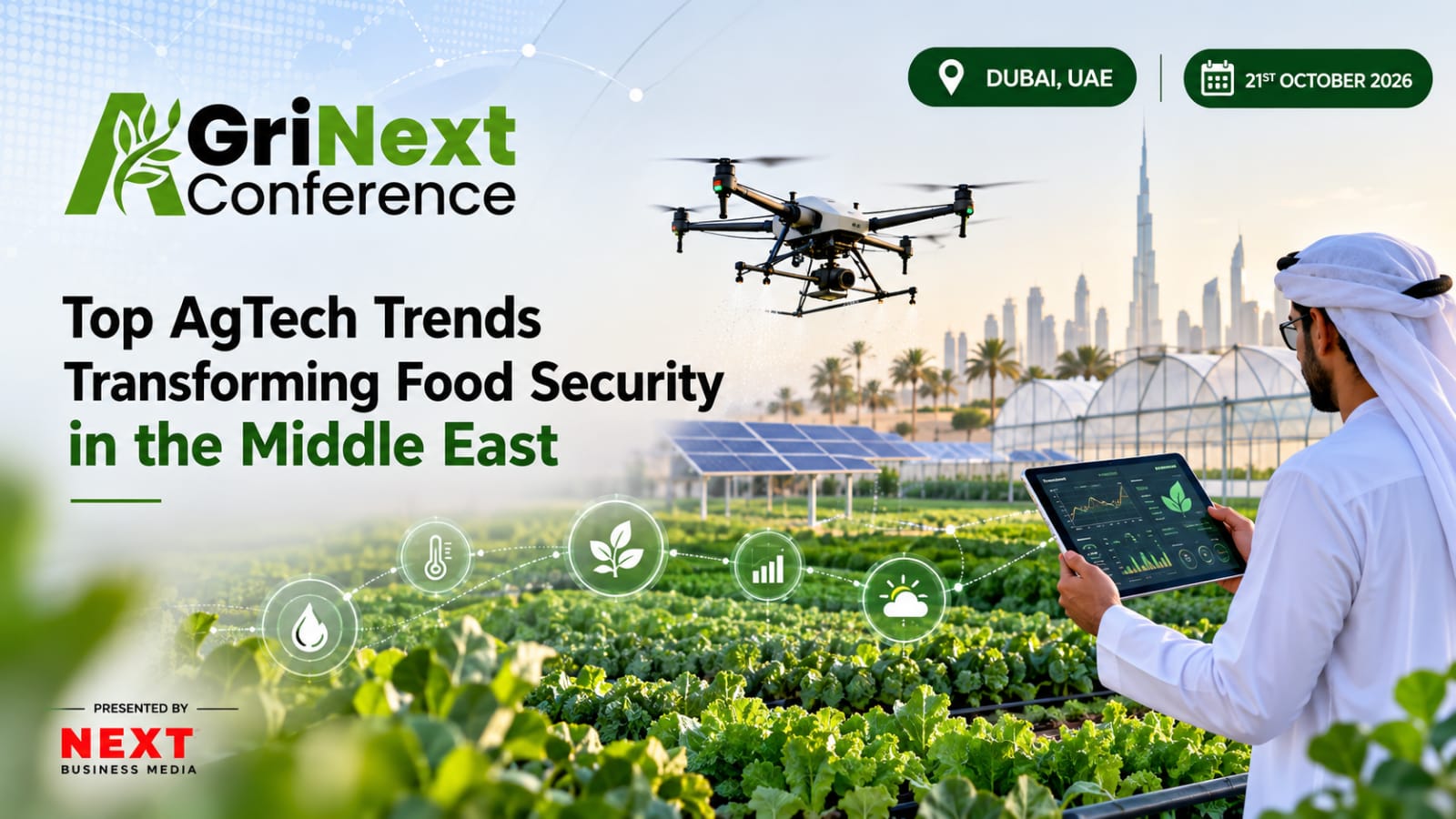
Top AgTech Trends Transforming Food Security in the Middle East
The Middle East is entering a new era of agricultural transformation. Faced with water scarcity, rising temperatures, population growth, and pressure on food supply chains, the region is accelerating investment in technologies that can improve productivity, conserve resources, and build long-term resilience.
Across the region, agriculture is moving beyond traditional farming methods. It is increasingly driven by data, automation, controlled environments, and smarter resource management. From AI-powered decision-making to vertical farming and precision irrigation, AgTech is helping farmers and policymakers rethink how food is produced in one of the world’s most climate-challenged regions.
Precision agriculture is becoming essential
Precision agriculture is one of the most important trends shaping the future of food production in the Middle East. By using sensors, satellite data, drones, and analytics, farmers can monitor soil conditions, crop health, water use, and input requirements with greater accuracy.
This approach can reduce resource waste and help growers make better decisions in environments where every drop of water matters. In a region where agricultural productivity must be achieved with limited resources, precision farming is moving from an emerging innovation to an increasingly important tool.
Smart irrigation is solving a critical challenge
Water scarcity remains one of the region’s biggest agricultural constraints. Smart irrigation systems are helping farmers use water more efficiently by automating irrigation schedules, monitoring soil moisture, and adjusting water delivery according to crop requirements and weather conditions.
This is particularly valuable in arid and semi-arid environments, where conventional irrigation can result in significant water losses. As governments and agribusinesses seek scalable approaches to sustainable agriculture, smart irrigation is becoming one of the most practical AgTech investments.
Vertical farming is expanding urban food production
Vertical farming and controlled-environment agriculture are gaining momentum as ways to produce fresh food closer to urban consumers. These systems use stacked growing environments, indoor facilities, and controlled conditions to cultivate crops with limited land and, in some systems, potentially lower water consumption than conventional farming.
For the Middle East, vertical farming can help reduce exposure to long and vulnerable food supply chains while increasing local production of selected crops. It is particularly relevant in locations where extreme heat, limited arable land, and water constraints make conventional outdoor farming more difficult.
AI and automation are improving farm decisions
Artificial intelligence is becoming an increasingly important component of modern agriculture. In the Middle East, AI-enabled tools can help farmers predict crop performance, identify potential disease risks, optimize irrigation, and improve farm and supply-chain planning.
Automation can also reduce labor requirements and improve consistency across farming operations. As agribusinesses seek more scalable and resilient production models, AI is helping connect field-level data with faster, more informed operational decisions.
Climate-resilient farming is a strategic priority
Climate change is intensifying agricultural risks across the region, including heat stress, irregular rainfall, and soil degradation. As a result, climate-resilient farming is no longer a niche concept but a strategic priority for the future of food security.
This includes adopting drought-tolerant crops, expanding protected cultivation, improving water efficiency, and using digital technologies to anticipate environmental stress. The ability to adapt farming systems to changing climatic conditions will be critical to strengthening the region’s long-term food resilience.
Why AgriNext Matters
AgriNext Awards and Conference brings together the people shaping the future of agriculture. With a focus on precision agriculture, smart irrigation, vertical farming, Agri-AI, automation, and climate-resilient farming, it offers a relevant platform for discussing agriculture’s next phase in the Middle East.
The conference connects regional challenges with the technologies, ideas, and partnerships that can help address them. For farmers, technology providers, agribusinesses, policymakers, and investors, it creates a space to explore how innovation can move from isolated applications to scalable solutions.
The future of agriculture in the Middle East will depend on how effectively innovation is turned into practical impact. Precision farming, smart irrigation, controlled-environment agriculture, AI, and automation are already helping build more efficient and adaptable food-production systems.
AgriNext Dubai provides a platform for these conversations, bringing together ideas, technologies, and industry leaders to shape the region’s agricultural transformation.
Reference
FAO Regional Office for Near East and North Africa —regional priorities on food security, greening agriculture, water scarcity, and climate action.