
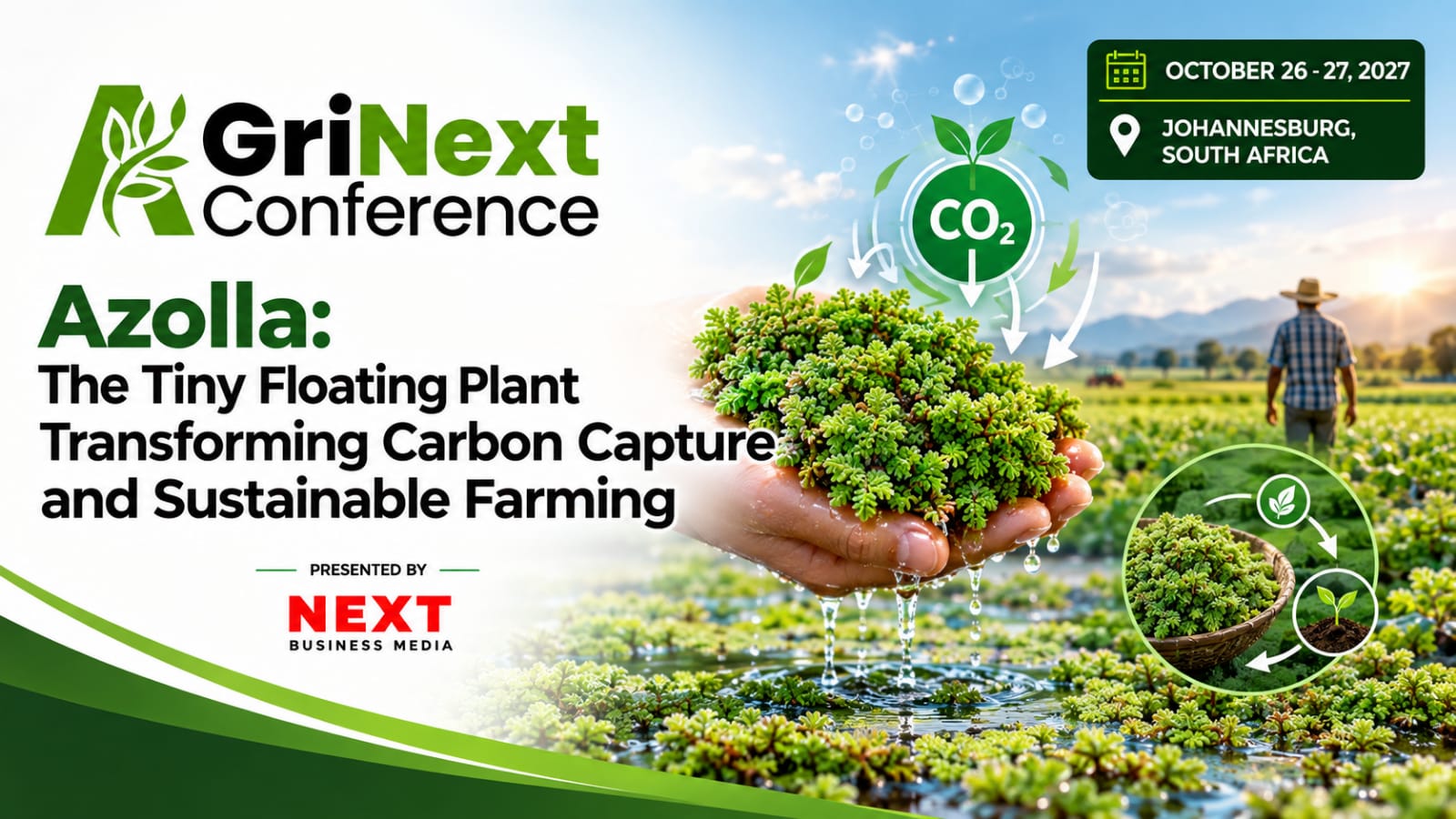
Carbon capture is often associated with large industrial facilities, engineered technologies and expensive infrastructure. But one potential nature-based approach is much smaller—and grows quietly on the surface of water.
Azolla, a fast-growing floating fern, is attracting attention for its potential to combine carbon uptake with improved soil fertility, lower fertilizer use and more sustainable rice production. Its strongest contribution may not be carbon storage alone, but the way it connects biological nitrogen fixation, biomass production and crop productivity.
A natural source of nitrogen
Azolla grows rapidly in freshwater environments and forms a symbiotic relationship with the nitrogen-fixing cyanobacterium Anabaena azolla. Through this association, the system captures atmospheric nitrogen and converts it into forms that can support plant growth.
When Azolla is used as green manure, its biomass can return nitrogen and organic matter to the soil. This may reduce the amount of synthetic fertilizer required by rice farmers, although it is better viewed as a complementary nitrogen source than a complete replacement for fertilizer.
Earlier research in Ghana demonstrated the scale of this opportunity. A local strain of Azolla pinnata produced approximately 18 tones of fresh biomass per hectare within four weeks, equivalent to about 25 kilograms of nitrogen per hectare. Combining Azolla with 40 kilograms of nitrogen fertilizer produced higher grain yields than several other treatments tested.
For African agriculture, this matters because synthetic nitrogen fertilizer can represent a significant input cost. Inefficient nitrogen use can also contribute to environmental emissions, making locally produced biological inputs potentially valuable for both farm economics and sustainability.
Evidence from Senegal
A recent study in the Senegal River Valley tested Azolla pinnata in farmers’ rice fields across five sites. Researchers compared conventional practices with Azolla additions and treatments in which Azolla replaced part of the urea input.
Adding Azolla increased rice grain yield by an average of 7.57%, a result reported as statistically significant. In treatments where Azolla replaced part of the urea, yields increased by 4.17% on average, although this difference was not statistically significant. However, input costs fell by 33% in the partial-replacement treatment.
The findings suggest that Azolla’s immediate value may lie not only in increasing yields, but also in helping farmers maintain productivity while reducing dependence on purchased nitrogen fertilizer. That distinction is important in regions where fertilizer prices, access and supply-chain disruptions can significantly affect farm profitability.
What happens to the carbon?
Azolla absorbs carbon dioxide through photosynthesis as it grows and converts it into biomass. When that biomass is incorporated into agricultural soils, some of its organic carbon may contribute to soil carbon stocks while its nutrients return to the crop system.
However, carbon uptake should not automatically be described as permanent carbon removal. Much of the biomass carbon may return to the atmosphere as carbon dioxide or methane as it decomposes. The amount retained in soil depends on factors including soil type, water management, decomposition rates, incorporation practices and the wider farming system.
For this reason, Azolla is better understood as a tool for integrated carbon and nutrient management than as a standalone carbon-capture technology. Its climate value should be assessed alongside changes in fertilizer use, soil carbon, rice yields, water consumption and greenhouse-gas emissions.
Potential benefits—and limits
Azolla can suppress weeds, reduce water evaporation and add organic matter when incorporated into the soil. It may also help reduce methane emissions in some rice systems when maintained as a floating cover or used in specific dual-cropping arrangements.
However, the climate benefits are not universal. Incorporating large amounts of Azolla biomass into flooded soils may increase methane emissions under some conditions. Results depend on the species, biomass quantity, timing of incorporation, fertilizer practices, water regime, soil conditions and local climate.
Azolla should therefore be assessed as part of the whole farming system, alongside rice yields, fertilizer use, water management and total greenhouse-gas emissions.
Scaling across Africa
Azolla should not be treated as a universal carbon-capture solution or a complete replacement for synthetic fertilizer. Its performance depends on species, temperature, water availability, nutrient conditions and farm management.
Scaling will require locally adapted field trials, reliable systems for multiplying and distributing Azolla, farmer training and practical methods for managing excess biomass. Ecological risks, including uncontrolled spread and effects on native aquatic plants, should also be assessed.
Digital monitoring could help measure Azolla’s effects on rice yields, fertilizer use, input costs, soil carbon, water management and greenhouse-gas emissions. This evidence will help identify where Azolla delivers the greatest benefits and where it may be less suitable.
Explore climate-smart agriculture
Discover how emerging nature-based solutions, regenerative practices and agricultural technologies are shaping a more productive and resilient food system across Africa.
Join AgriNext Awards and Conference Africa to connect with farmers, agribusiness leaders, investors, innovators and technology providers working on the next generation of sustainable agriculture.