
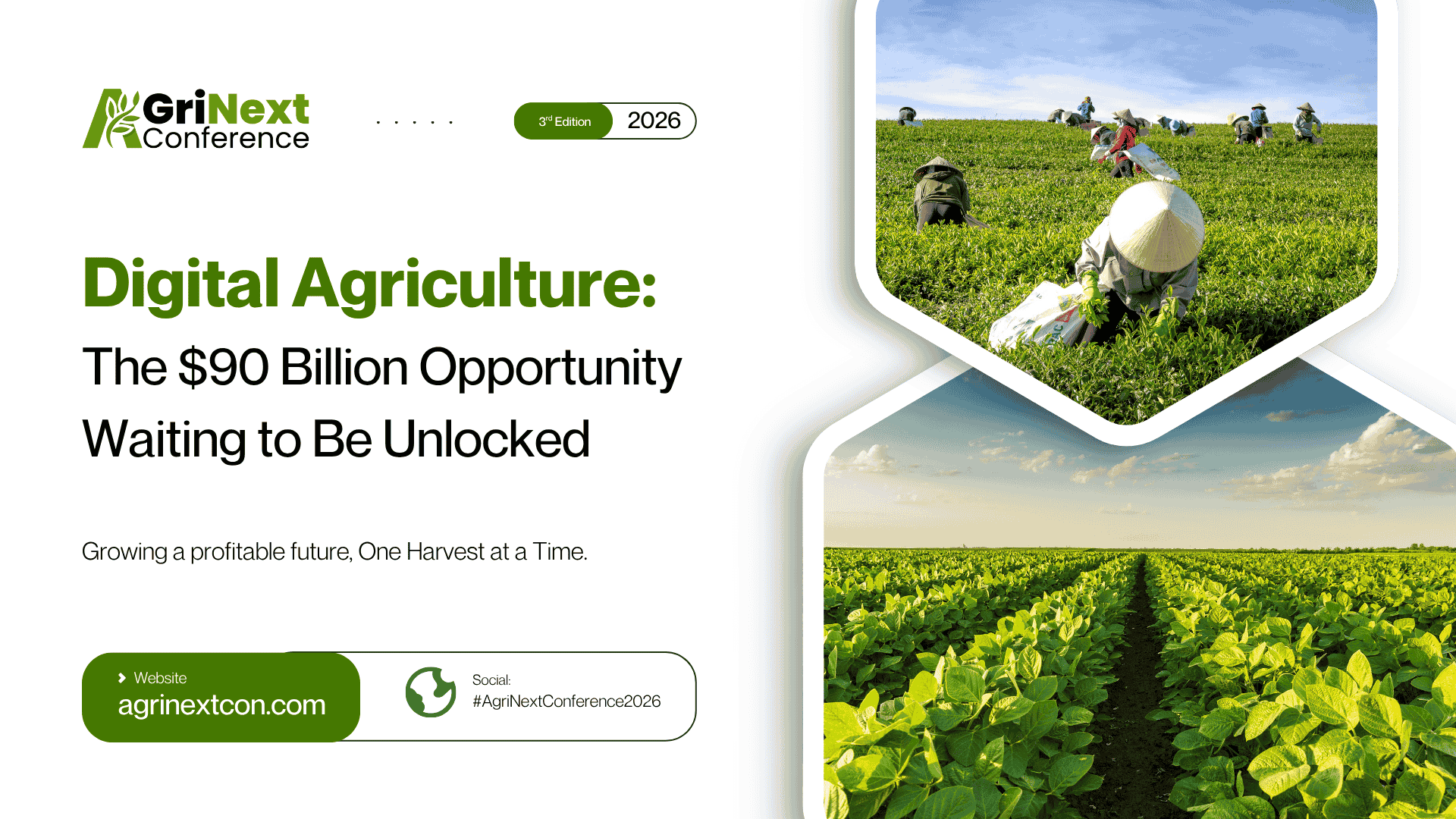
The Trillion-Dollar Backbone Meets a Digital Revolution
Agriculture powers emerging markets, employing nearly 40% of the global workforce (FAO data). Yet analogue inefficiencies trap its potential. Insights from McKinsey Global Institute highlight that digital transformation could unlock a $90 billion annual GDP boost in Southeast Asia by 2033—a projection also echoed in coverage by The Economic Times.
Why $90 Billion? Closing the Yield Gap
The opportunity exists because of a massive yield gap—in some regions, smallholder yields remain 2–6 times below potential due to fragmented data and limited access to inputs.Digital tools are not optional innovation; they are the primary lever to close this gap by solving:
• Post-Harvest Losses: Currently costing regions billions annually due to poor storage and logistics.
•The Financing Gap: Farmers face a significant credit shortfall—often estimated in the tens of billions—which agri-fintech can help bridge through digital identities and alternative credit scoring.
The New Investment Reality: Quality Over Quantity
The road to $90 billion is being paved with a new kind of capital. Following a sharp correction in 2022, the agritech investment landscape has shifted from speculative growth to disciplined, patient capital.
Investors are no longer chasing moonshots. Instead, they are doubling down on:
Profitability & Unit Economics: Startups with clear paths to profit and robust business models are winning the flight to quality.
Automation & Robotics: To combat a global labor crisis, investment in precision robotics and autonomous harvesting is defying the general market slowdown.
AI as Connective Tissue: Capital is surging into AI that moves beyond buzzwords, focusing on real-time soil intelligence and multilingual farmer advisory tools.
Four Pillars of the Future
To capture this value, the industry is focusing on four critical verticals:
1.Digital Value Chains: Direct-to-market platforms that remove inefficient middlemen and increase farmer margins.
2.Inclusive Agri-Fintech: Using production data—not just land collateral—to unlock insurance and loans for smallholders.
3.Agrifood Life Sciences: Leveraging AI for crop intelligence and biologicals (biostimulants) to meet nature-positive global targets.
4.Digital Public Infrastructure (DPI): Adopting models like India’s AgriStack, a national-scale digital infrastructure enabling faster and lower-cost scaling of agritech solutions.
The Roadmap: From Pilot to Platform
The road to $90 billion isn’t just about individual startups; it’s about infrastructure. We are moving away from small-scale pilot programs toward integrated farming ecosystems. Success in this new era requires single-market execution—mastering one region’s unique value chain before attempting to scale globally.
Conclusion: More Than Just Profit
Unlocking $90 billion isn’t just about corporate gains—it’s resilience for food security. At the AgriNext Awards & Conference ,global leaders, investors, and agritech innovators converge to shift from What is possible? to How do we scale responsibly? Expect keynotes on AI-driven yield optimization, DPI case studies, and awards celebrating profitability-first startups. Join to network, validate pilots, and turn digital data into ground-level impact—register now for actionable insights on unlocking the $90 billion opportunity in emerging markets.
Signup For AgriNext Conference Newsletter


 Reach us on WhatsApp