
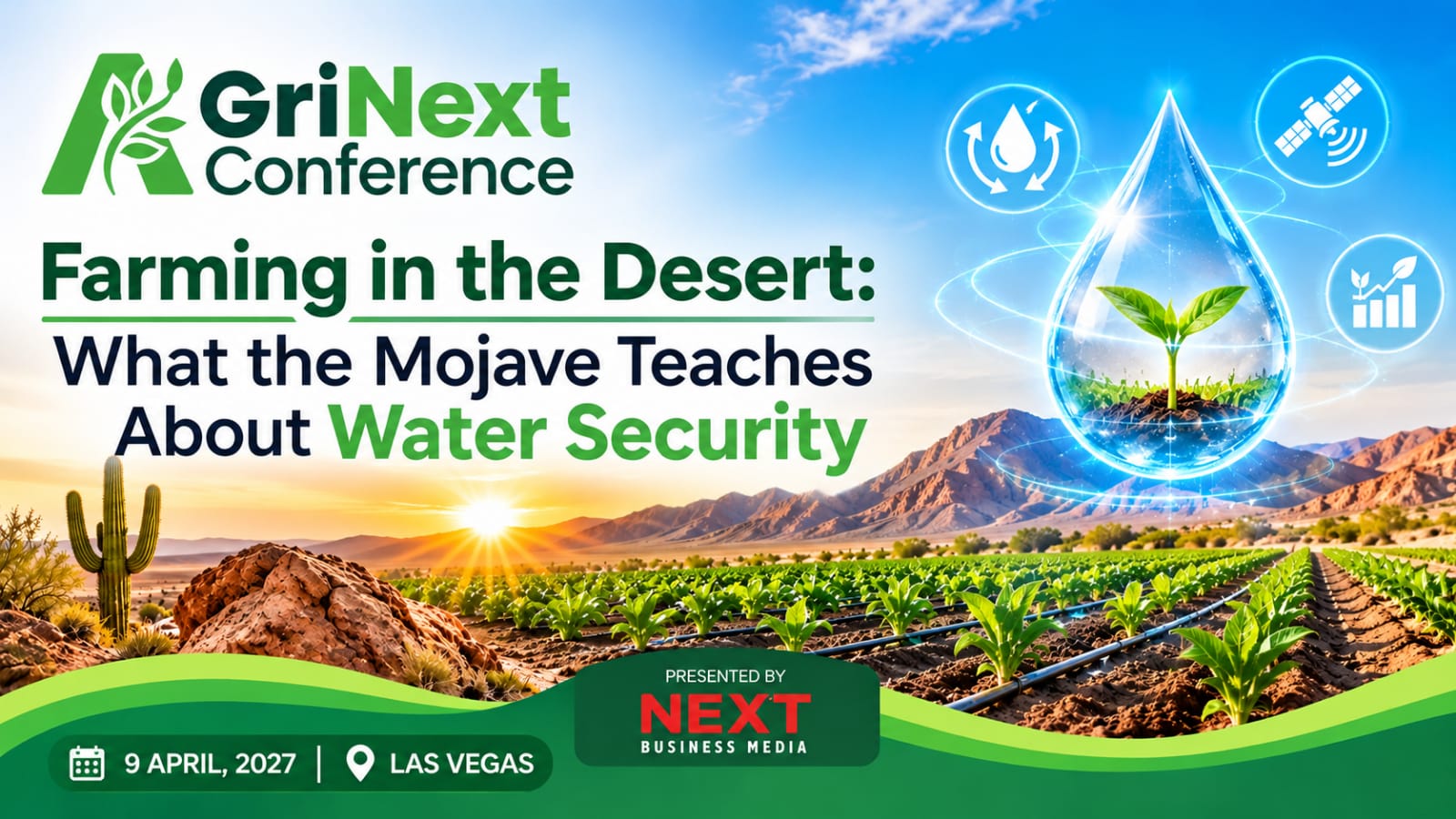
Las Vegas may seem like an unusual place for a global agriculture conference. It sits in the Mojave Desert, one of the driest regions in North America, and is better known for resorts and entertainment than farming.
But the region is also an important example of how communities can manage water when supplies are limited. As droughts, shrinking groundwater, and changing weather affect agriculture around the world, Nevada and the wider Desert Southwest offer useful lessons in water conservation, reuse, and efficient food production.
Making the Most of Every Drop
In areas with plenty of water, waste can be easy to overlook. In the Mojave, water is carefully measured, treated, and reused.
Southern Nevada has developed an extensive water-recycling system that captures and treats indoor wastewater before returning it to the Colorado River through the Las Vegas Wash. This system helps the region stretch its limited water supply.
Agriculture can apply the same principle. Instead of using water once and releasing it, farms can use recycled wastewater, closed-loop hydroponic systems, and subsurface drip irrigation. These methods deliver water directly to plant roots, reducing evaporation and waste.
Finding New Water Sources
When reservoirs such as Lake Mead face low levels, communities and researchers are looking beyond traditional water sources.
One area of innovation is atmospheric water generation, or AWG. These systems pull moisture from the air and turn it into usable fresh water. For example, University of Nevada, Las Vegas (UNLV) startup WAVR Technologies is developing atmospheric water harvesting systems that capture moisture from the air, including in dry climates, using a liquid desiccant and specialized high-surface-area technology.
Meanwhile, Alejandro J. Trueba Carranza, Founder of Startup Renaissance and a featured speaker at AgriNext Las Vegas 2027, is associated with science-based rainfall enhancement initiatives and approaches to watershed conservation aimed at supporting agricultural water security in drought-prone regions.
These approaches do not replace careful water use, but they can add to a broader water-security strategy.
Growing Food in Controlled Environments
During summer, temperatures in parts of the Desert Southwest can exceed 110°F (43°C), creating challenging conditions for outdoor crop production.
Controlled Environment Agriculture, or CEA, offers an alternative. Vertical farms and climate-controlled greenhouses allow growers to produce crops such as leafy greens and berries throughout the year, regardless of outdoor weather.
Some recirculating vertical farming systems can use around 90–95% less water than conventional field production, particularly for leafy greens. These savings depend on the crop and growing system.
CEA can also bring food production closer to cities, reducing transport needs and supporting local food supplies.
At AgriNext USA 2027, vertical farming pioneers and ecosystem builders—including Tisha Livingston, co-founder of 80 Acres Farms and CEO of Infinite Acres—will discuss how controlled-environment agriculture can support year-round food production in cities and water-stressed regions.
Measuring Yield Per Drop
For many years, farms were judged mainly by how much they produced per acre. In water-limited regions, a more useful measure is how much food can be produced for every unit of water used.
Growers are increasingly using soil moisture sensors, satellite data, and AI-based tools to decide exactly when and how much to irrigate. Regulated deficit irrigation involves strategically reducing water applications during selected growth stages while protecting crop yield and quality.
Farmers are also using soil amendments and biological inputs that improve the soil’s ability to hold water. Together, these tools can help maintain crop yields while reducing overall water withdrawals.
Sharing These Lessons Globally
Water security is no longer only a concern for desert regions. It is becoming a major issue for farms, food companies, and investors worldwide.
The 4th Edition of the AgriNext Awards & Conference will take place on April 9, 2027, at the JW Marriott Las Vegas Resort & Spa. The event will bring together growers, AgTech companies, researchers, and investors to discuss practical solutions such as atmospheric water generation, AI-supported irrigation, water recycling, and water reduction in food processing.
The Mojave Desert shows that farming in dry conditions is possible when water is treated as a limited and valuable resource. Its experience can help other regions prepare for a future where efficient water use becomes essential to food production.