
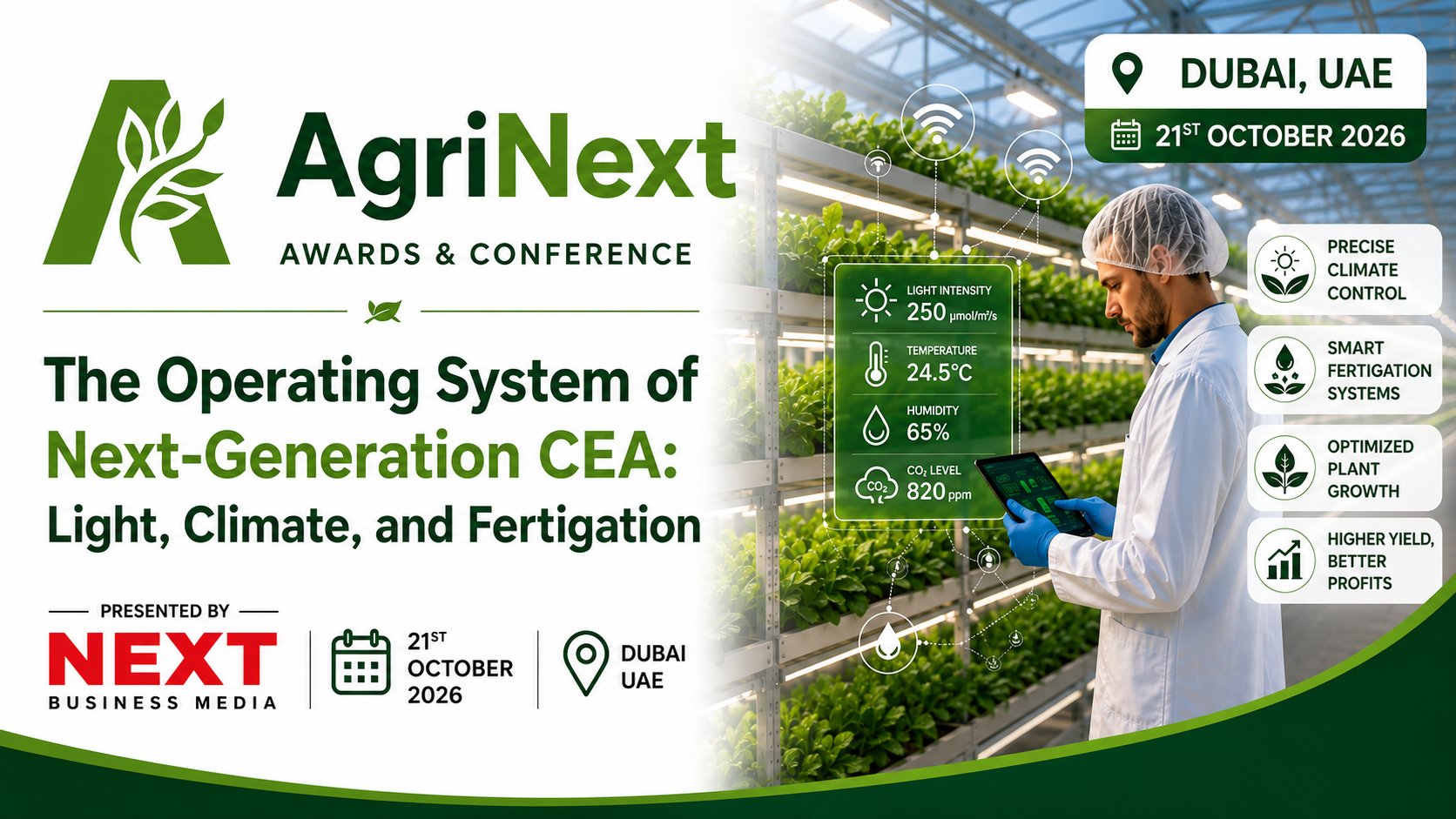
The operating system of next-generation Controlled Environment Agriculture (CEA) is the orchestration layer that unifies lighting, climate, and fertigation into a single closed-loop system. In hyper-arid regions such as the Middle East, this software infrastructure is no longer a luxury; it is essential for resource-efficient production and food security.
LED Spectra Optimization
Light is more than illumination in CEA — it is a tool for shaping plant growth. By adjusting LED spectra, growers can influence plant morphology, flowering, biomass, and nutritional quality, though optimal settings vary by crop and growth stage. In markets such as Dubai, where demand for high-value leafy greens, herbs, and specialty crops remains strong, optimized lighting can improve productivity and commercial returns.
Climate Control
In the Gulf, extreme heat and high cooling demands make climate management essential. Smart systems regulate temperature, humidity, airflow, and CO2 levels to reduce crop stress, lower energy penalties from ambient heat, and maintain consistent microclimates. This stability supports year-round production and helps make indoor farming commercially viable. The need for rigorous climate control is especially critical in vertical farms, where failing to maintain conditions can directly affect yield and product quality.
Automated Fertigation
Automated fertigation delivers water and nutrients according to crop requirements through controlled dosing systems. Often linked with EC, pH, and substrate-moisture sensors, it improves nutrient uptake, reduces fertilizer loss, conserves water, and supports more sustainable production. In water-scarce regions such as the UAE, precision fertigation is both an operational advantage and a food security priority.
Regional Scaling
A major regional example is Emirates Bustanica in Dubai, which integrates advanced lighting, climate control, and automated fertigation. Its success demonstrates how controlled environment agriculture can deliver year-round, resource-efficient production in arid climates. New projects in Dubai’s Food Tech Valley are also adopting modular, technology-driven farming systems to improve resource efficiency and support circular food production.
By standardizing digital growing environments, future facilities can replicate proven cultivation profiles, accelerate deployment, and adapt production to local climate and grid conditions. This approach has the potential to strengthen regional food security while making high-tech farming more commercially viable. Benchmarks in the sector also show that lighting and HVAC efficiency are major drivers of overall performance, reinforcing the value of integrated control.
Looking Ahead
The next generation of CEA will rely increasingly on artificial intelligence, sensor networks, and data-driven automation to coordinate lighting, climate, and fertigation as a single integrated system. Rather than managing these elements separately, growers will use real-time data to optimize resource use, improve crop quality, and respond quickly to changing conditions. Realizing that vision will require robust sensor networks, interoperable data standards, and models trained on local crop and environment data.
As the UAE continues to strengthen its food security strategy and invest in sustainable agriculture, CEA technologies are expected to play an increasingly important role in the country’s agricultural landscape. For technology providers, greenhouse operators, researchers, and investors, the question is no longer whether controlled environment agriculture can work in the region, but how it can scale efficiently and economically.
The future of controlled environment agriculture lies in integrating lighting, climate, and fertigation into intelligent, data-driven production systems. AgriNext Awards & Conference will explore how these innovations are being deployed at scale to improve productivity, efficiency, and resilience.
Signup For AgriNext Conference Newsletter


 Reach us on WhatsApp