
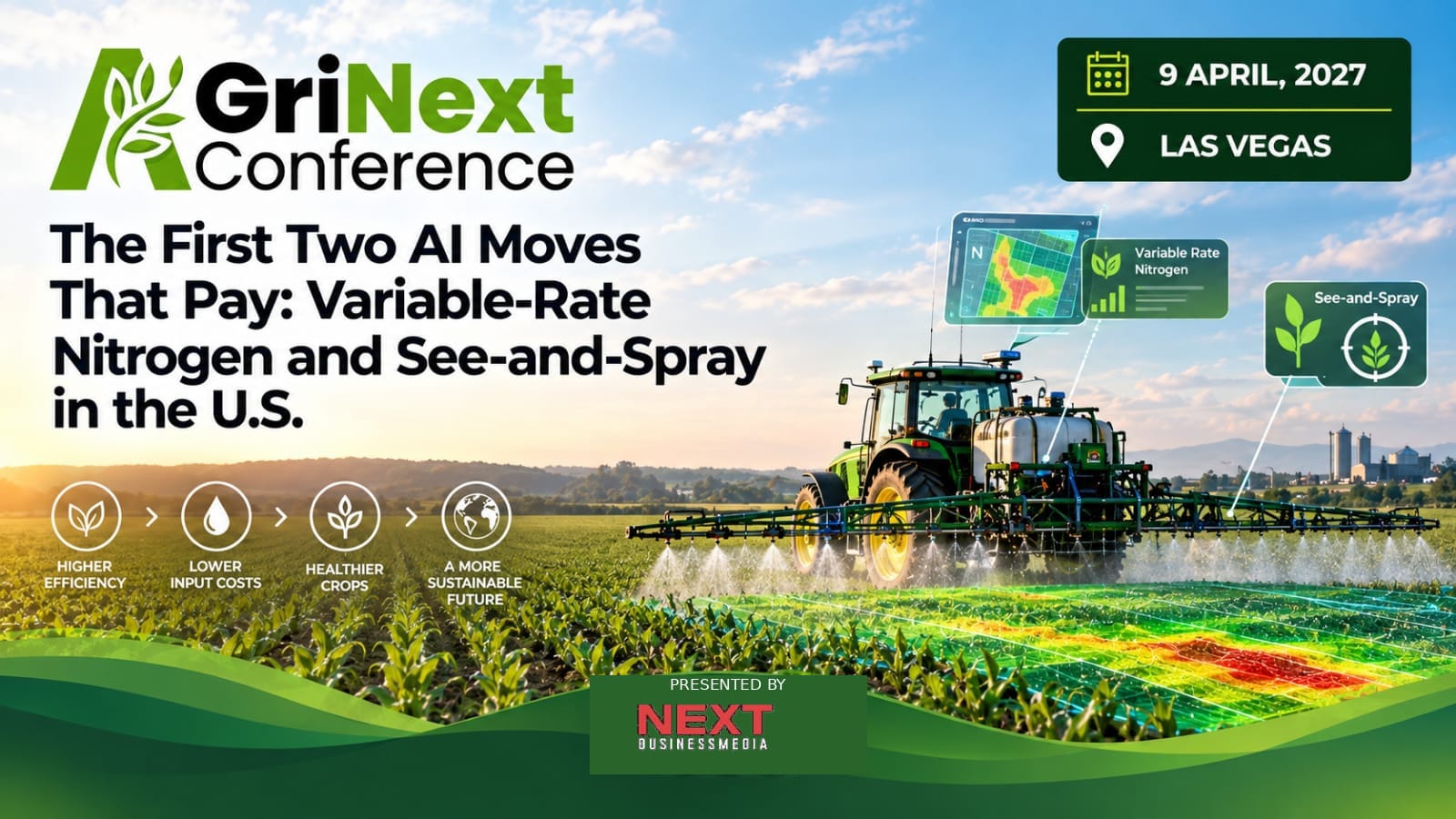
For U.S. row-crop operators building a digital-first farm, two practical AI-enabled applications stand out: variable-rate nitrogen (VRN) and computer-vision-based see-and-spray weed control. Both use field-level data to make input decisions more precise, while allowing farmers to measure the economic impact through fertilizer and herbicide use.
The economics vary significantly by crop, field conditions, input prices, weed pressure, technology costs and the quality of the underlying data. That makes these technologies less about a universal payback number and more about identifying fields where precision application can create measurable value.
Why these two use cases matter
VRN and targeted spraying address two major input categories: nitrogen fertilizer and herbicides. They also build on data and equipment increasingly common across U.S. farms, including yield maps, crop imagery, sensors, section control and farm-management platforms.
That makes them practical entry points for digital agriculture. Instead of starting with a complex AI pilot, operators can apply data-driven decision-making to an existing production workflow and measure changes in input use, yield and field-level profitability.
Variable-rate nitrogen: what the evidence shows
Midwest research from the early 2020s highlights both the opportunity and the variability of VRN. A study covering 17 field-years across 13 Midwest fields from 2021 to 2023 found that the profitability of prescriptions based on remote sensing compared with yield-history-based prescriptions ranged from −$410 to +$350 per hectare. The results varied by season: NDVI-based prescriptions performed better when early-season crop conditions persisted, while yield-history prescriptions performed better when early-season conditions did not persist.
That finding is important because it shows why VRN should not be treated as an automatic saving. The value comes from matching the nitrogen recommendation to actual field and seasonal conditions.
A separate Nebraska SARE project evaluated crop-canopy sensing and variable-rate, in-season nitrogen application. The project found that sensor-guided in-season nitrogen management can reduce nitrogen application while maintaining production and improving economic performance, although results differed between years and sites.
There is also a more immediate opportunity for growers to revisit nitrogen rates even without deploying a new VRN system. A March 2026 analysis from the University of Illinois found that higher nitrogen prices reduced the economically optimal MRTN rate for central Illinois corn. Under its spring 2026 pricing scenario, reducing the recommended rate by 8 lb nitrogen per acre could save about $4.88 per acre with anhydrous ammonia or just over $7 per acre with liquid nitrogen or urea, depending on the product used.
How VRN creates value
VRN translates differences in soil, historical yield, crop vigor and growing-season conditions into more targeted nitrogen recommendations. The goal is not simply to apply less nitrogen. It is to improve the relationship between nitrogen availability, crop demand and the economics of each field.
The SARE research demonstrates the potential of crop sensors to direct in-season N applications, while newer Midwest research shows that combining yield history with current-season crop-vigor information can improve prescription decisions.
That distinction matters. A digital-first farm should evaluate VRN by measuring nitrogen applied, yield response, nitrogen-use efficiency and net return rather than relying on a fixed percentage-saving assumption.
See-and-spray: measurable savings from targeted application
Computer-vision spraying provides another relatively direct way to connect AI with input economics. Systems such as John Deere See & Spray use cameras and onboard processing to identify weeds and activate individual spray nozzles, allowing herbicide to be applied only where weeds are detected.
John Deere reported that its See & Spray technology was used across more than 5 million acres during the 2025 growing season. Customers reduced non-residual herbicide use by an average of nearly 50%, saving nearly 31 million gallons of herbicide mix. These figures are company-reported commercial deployment results rather than a controlled independent trial, but they demonstrate that targeted spraying has reached substantial operating scale.
Independent research also shows that targeted spraying can produce substantial reductions in herbicide use. A 2026 Association of Equipment Manufacturers review cited research showing reductions ranging from roughly 40% to 60% in targeted-spray applications, while individual studies have reported wider ranges depending on weed distribution, crop and operating conditions.
The economic benefit is therefore highly dependent on the field. Patchy weed pressure creates more opportunity for targeted application because a large proportion of the field may not require a full-rate broadcast treatment.
When see-and-spray has the strongest economic case
The technology is particularly relevant where weeds are spatially variable and post-emergence herbicide applications represent a significant portion of crop-protection costs.
Farmers evaluating the technology should compare broadcast herbicide use with targeted application on a field-by-field basis. Important measurements include gallons or pounds of active ingredient applied, acres actually sprayed, technology and licensing costs, weed-control performance, crop response and total herbicide expenditure.
This approach produces a more reliable farm-specific ROI than applying a single industry-wide savings percentage.
From AI pilots to measurable farm economics
For U.S. agribusinesses and AgTech providers, the lesson is not that every farm will achieve the same ROI from VRN or see-and-spray. It is that these technologies offer relatively clear pathways for connecting AI with measurable production decisions.
The strongest business case comes when technology is evaluated against real field conditions, input prices and farm-level economics. VRN can use historical and in-season information to refine nitrogen decisions, while computer vision can make herbicide application more targeted. Both also generate operational data that can support more advanced digital agriculture strategies.
For growers, lenders, investors and technology providers, that combination of measurable inputs, field-level data and repeatable decision-making is an important foundation for scaling AI in U.S. agriculture.
AgriNext Awards & Conference USA 2027
The conversation around practical AI adoption in agriculture will continue at AgriNext Awards & Conference USA 2027, taking place on 9 April 2027 at JW Marriott Las Vegas Resort & Spa, Las Vegas, USA. The event brings together growers, agribusiness leaders, AgTech innovators, investors, researchers and policymakers to explore AI, precision farming, sustainability and other technologies shaping the future of agriculture.
Learn more: agrinextcon.com
References
University of Illinois FarmDoc — High Fertilizer Prices Suggest Reconsidering Application Rates
SARE — New technologies for improving sustainability of corn Nitrogen management